
Debt Consolidation Loans for Seniors: A 2026 Guide
Last Reviewed: June 2026 | By Sharon O’Day, Senior Advisor | Fact-checked by the Grandfolk Editorial Team






With the average credit card interest rate sitting around 20% or higher in 2026, near historic highs, carrying a balance from month to month has become punishingly expensive. Debt consolidation is one way to get that under control: it combines several debts into a single payment, ideally at a lower, fixed rate. This guide explains, in plain language, what a debt consolidation loan is, the main ways to consolidate, when it’s a smart move (and when it isn’t), what it costs, the special points retirees should weigh, and, importantly, how to avoid the debt-relief scams that frequently target older adults.
This article is educational and is not personalized financial advice. Free nonprofit credit counseling can help you compare options for your situation.
What is a debt consolidation loan?
A debt consolidation loan combines several debts, most often high-interest credit cards, into one new loan with a single monthly payment. The goal is usually a lower interest rate, a fixed payoff date, and the simplicity of paying one bill instead of several. Consolidation doesn’t erase what you owe; it reorganizes it so the debt is easier to manage and, ideally, cheaper to pay off.
For example, if you owe $12,000 across three cards at around 22% APR, replacing them with a single fixed-rate loan at a lower rate can reduce both your monthly cost and the total interest you pay, as long as you stop adding new charges to the cleared cards.
The main ways to consolidate debt
Personal (debt consolidation) loan
An unsecured personal loan is the most common tool. You borrow a fixed amount, repay it over a set term (often two to seven years) at a fixed rate, and use it to pay off your other balances. Rates vary widely by credit profile, so compare offers. Because it’s unsecured, you aren’t putting your home or other assets at risk.
Balance-transfer credit card
If you have good credit, a balance-transfer card with a 0% introductory APR (often 12 to 21 months) lets you pause interest while you pay down the balance. Watch for a balance-transfer fee, usually 3% to 5% of the amount moved, and make sure you can clear the balance before the promotional rate ends and the regular APR kicks in.
Home equity loan or HELOC
Homeowners can borrow against their equity with a home equity loan or line of credit, often at a lower rate than unsecured debt. The serious trade-off: this debt is secured by your home, so falling behind could put the house at risk. For many seniors that risk outweighs the savings, so weigh it carefully. A reverse mortgage is a different option some older homeowners consider, with its own rules and costs.
Debt management plan (nonprofit credit counseling)
A nonprofit credit counseling agency can set up a debt management plan (DMP): you make one monthly payment to the agency, which distributes it to your creditors, often after negotiating lower interest or waived fees. This isn’t a loan, and reputable agencies charge little or nothing for an initial session. Start with the National Foundation for Credit Counseling or the Consumer Financial Protection Bureau.
Debt settlement and why to be careful
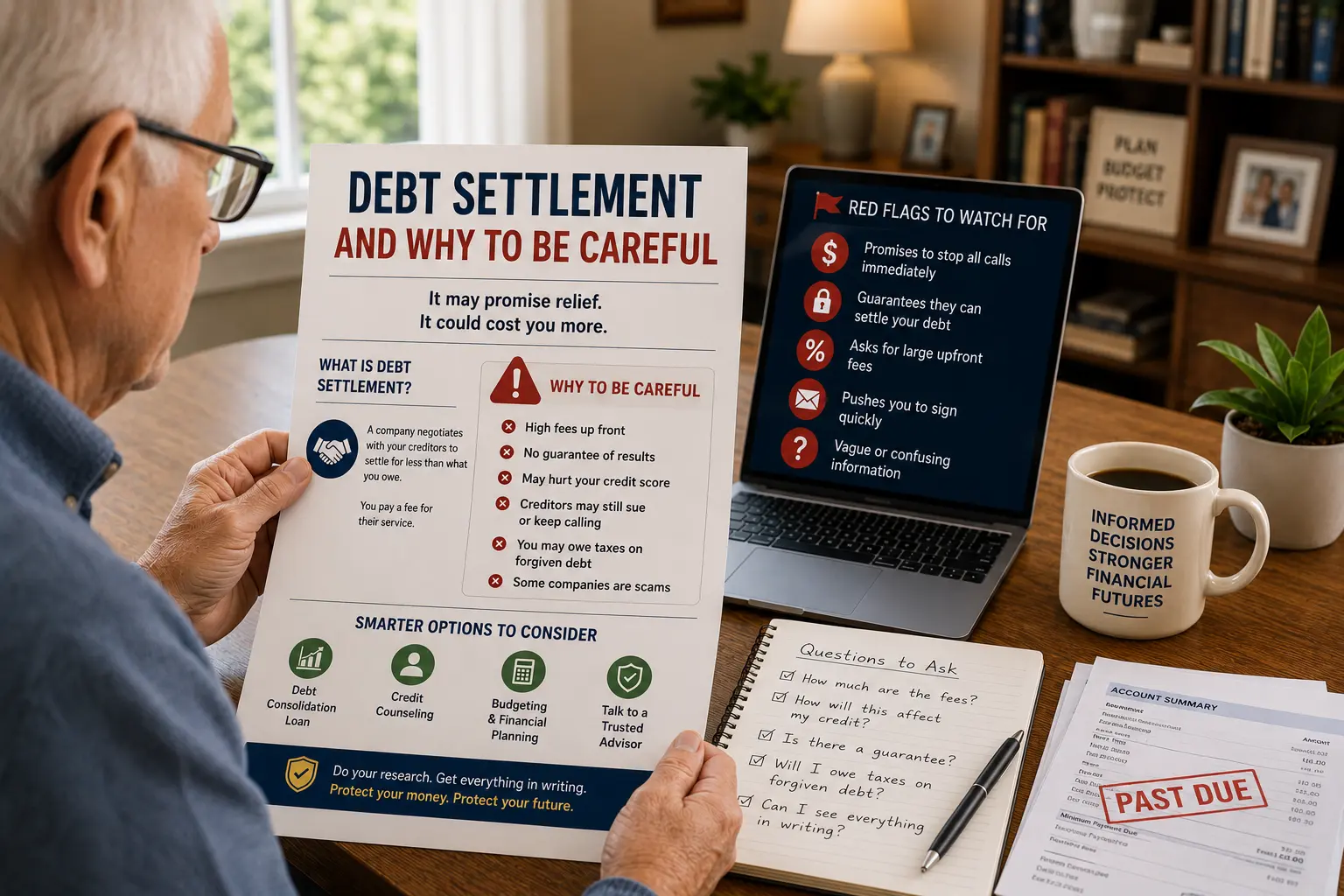
Debt settlement companies promise to get creditors to accept less than you owe. It can reduce balances, but it typically damages your credit, the forgiven amount may count as taxable income, and this is the corner of the industry with the most fraud. See the scam-avoidance section below before considering it.
Pros and cons of debt consolidation
- Pros: one payment instead of several; potentially a lower interest rate; a clear payoff date; on-time payments can help your credit over time.
- Cons: you may pay more total interest if you stretch the term too long; secured options risk your home; it doesn’t fix overspending; and if you run the cards back up, you’ll be worse off.
When debt consolidation makes sense (and when it doesn’t)
It tends to make sense when you can qualify for a meaningfully lower rate, the new single payment fits your budget, and you’re committed to not adding new debt. It’s usually not the answer if your real problem is spending more than you take in, if the only loan you qualify for costs as much as your current debt, or if your total debt is so large relative to your income that nonprofit counseling or even bankruptcy advice would serve you better.
How to qualify
Lenders look mainly at your credit score, your debt-to-income ratio (monthly debt payments divided by monthly income), and proof of steady income, which, for retirees, can include Social Security, pensions, and retirement-account withdrawals. A higher score generally means a lower rate. If your credit is weak, a nonprofit DMP may be a better route than a high-rate loan.
What it costs
Compare the full cost, not just the monthly payment:
- Interest rate (APR): The main number; lower is better, and fixed rates are predictable.
- Origination fee: Some personal loans charge a percentage of the amount borrowed, deducted up front.
- Balance-transfer fee: Typically 3% to 5% on transfer cards.
- Total interest over the life of the loan: A longer term lowers the payment but can raise the total you pay.
A simple worked example
Say you owe $12,000 on cards at 22% APR and you’re paying about $360 a month, headed for years of payments and thousands in interest. Move it to a 3-year fixed loan at a lower rate and you’d have one predictable payment and a definite payoff date, with less interest overall, provided you don’t reuse the cards. Run your own numbers with a loan calculator before committing.
Special considerations for seniors and retirees
On a fixed income, predictability matters most. Favor a fixed rate and a payment you can comfortably cover every month. Think hard before securing debt against your home. And be especially alert to unsolicited debt relief pitches, because older adults are a frequent target, as the next section explains.
How to avoid debt-relief scams (red flags)

This is essential. In 2025 the Federal Trade Commission acted against a debt-relief operation that targeted older Americans and veterans and cost victims about $100 million. In one instance, it charged a disabled veteran roughly $10,000 in illegal up-front fees. Protect yourself by treating these as red flags, based on FTC guidance
- Up-front fees, Under FTC rules, a for-profit company selling debt-relief services by phone cannot charge a fee before it actually settles or reduces a debt. Anyone demanding payment first is breaking the law.
- Guarantees. Promises to erase a specific percentage of your debt (we’ll cut it 60%) are a warning sign.
- Stop paying your creditors. Being told to stop paying or to cut off contact with creditors can wreck your credit and is a classic scam tactic.
- High pressure. Urgency to act now, refusal to put terms in writing, or unsolicited calls and texts.
- Fake nonprofit status. Some scammers falsely claim to be nonprofits, so verify before you trust.
If something feels off, slow down and check it. You can report suspected fraud at ReportFraud.ftc.gov.
Where to get free, trustworthy help
Before paying anyone, talk to a legitimate, low-cost or free resource: a nonprofit credit counselor through the NFCC, the consumer guidance at the CFPB, or general money education at MyMoney.gov. A counselor can review your full picture and tell you honestly whether consolidation, a DMP, or another path fits best.
How to consolidate, step by step
- List your debts: balances, interest rates, and minimum payments.
- Check your credit so you know what rates you’re likely to qualify for.
- Compare options (personal loan, balance transfer, DMP) by total cost, not just monthly payment.
- Get quotes from a few reputable lenders or a nonprofit counselor; read the terms in writing.
- Consolidate and pay off the old balances, then keep those accounts at a zero balance.
- Make every payment on time and avoid taking on new debt.
Frequently asked questions
What is a debt consolidation loan?
It combines several debts, often high-interest credit cards, into one new loan with a single monthly payment, ideally at a lower fixed rate. It reorganizes your debt to make repayment simpler and potentially cheaper; it doesn’t erase what you owe.
Is debt consolidation a good idea for seniors on a fixed income?
It can be, if you qualify for a lower rate and the single payment fits your budget. Be cautious about secured options that put your home at risk, and don’t stretch the term so long that you pay more interest overall. Free nonprofit credit counseling can help you compare options.
Does debt consolidation hurt your credit score?
Applying may cause a small, temporary dip from a hard inquiry, but consistent on-time payments and lower credit utilization can improve your score over time. Debt settlement, by contrast, usually damages your credit.
What’s the difference between debt consolidation and debt settlement?
Consolidation combines debts into one loan you repay in full. Settlement tries to get creditors to accept less than you owe, which can hurt your credit and may create taxable forgiven-debt income, and it’s the area with the most scams.
How can seniors avoid debt-relief scams?
Be wary of any company that charges fees before settling a debt (illegal under FTC rules), guarantees to erase a set percentage, tells you to stop paying or talking to creditors, or pressures you to act fast. Start with free nonprofit credit counseling and verify any company before paying.
How much debt do I need before consolidating?
There’s no fixed minimum. Consolidation is most worthwhile when you carry enough high-interest balance that a lower rate produces real savings and a single payment genuinely simplifies your finances.
The bottom line
Debt consolidation can turn several expensive, high-interest balances into one manageable, lower-rate payment, a real relief when card rates are near record highs. The keys are to qualify for a genuinely lower rate, avoid securing the debt against your home unless you fully understand the risk, resist running the cards back up, and steer clear of any debt relief outfit that charges up-front fees or makes big guarantees. When in doubt, start with free nonprofit credit counseling and compare your options before signing anything.

Sharon O'Day - Senior Advisor
Sharon O'Day is the Health editor at Grandfolk, where she commissions and reviews fitness, wellness, and senior-care content for accuracy, clarity, and real-world usefulness. At 60-plus, she writes for older adults from lived experience, testing the advice against the questions she and her peers actually ask. She focuses on guidance that is honest about both the benefits and the limits, and that always points readers back to their own doctor for personal decisions.