
Reverse Mortgages Explained: How They Work & 2026 Costs
Last Reviewed: June 2026 | By Sharon O’Day, Senior Advisor | Fact-checked by the Grandfolk Editorial Team






For many retirees who are house rich and cash poor, the largest asset they own is the home they live in. A reverse mortgage is one way to turn part of that equity into cash without selling or moving, but it’s a complex product that works opposite to a regular mortgage, and the details matter enormously for you, your spouse, and your heirs. Whether a celebrity spokesperson made it sound simple or a mailer made it sound urgent, this is a decision to research carefully so it fills a real need without creating outsized risk.
What is a reverse mortgage?
With a regular mortgage, you make payments to build equity. A reverse mortgage flips that: you borrow against the equity you’ve already built, and instead of you paying the lender, the lender pays you. You keep the title to your home, you’re not signing it over to the bank. You make no monthly principal-and-interest payments; instead, interest and fees are added to the loan balance over time, and the whole balance comes due when the last borrower sells the home, moves out permanently, or passes away. Because the balance grows while your equity shrinks, a reverse mortgage is not free money.
The three types of reverse mortgage
HECM (FHA-insured)
The Home Equity Conversion Mortgage is the federally insured reverse mortgage offered through HUD’s Federal Housing Administration, and it accounts for the large majority of reverse mortgages. The FHA’s involvement adds real consumer protections, mandatory counseling, capped fees, and a guarantee that you and your heirs will never owe more than the home is worth. The rest of this guide focuses on HECMs; the CFPB’s reverse-mortgage resource is a good companion read.
Proprietary / jumbo reverse mortgages
Private loans not insured by the FHA, designed for higher-value homes above the HECM limit, some allow access up to about $4 million, and some accept borrowers as young as 55. The trade-off: they carry fewer of the FHA’s consumer protections, often come as fixed-rate lump sums, and may charge higher rates.
Single-purpose reverse mortgages
The lowest-cost option, offered by some state and local governments and nonprofits, but the proceeds can only be used for a lender-specified purpose (such as property taxes or home repairs). They’re typically aimed at low- to moderate-income homeowners and aren’t available everywhere.
Who qualifies? (eligibility and the financial assessment)
For an FHA HECM you must:
- Be age 62 or older (the youngest borrower on the loan);
- Own the home outright or have enough equity that the loan can pay off any remaining balance at closing;
- Live in the home as your primary residence; and
- Be able to keep paying property taxes, homeowners insurance, and upkeep.
Eligible properties include single-family homes, 2-to-4-unit homes where you occupy one unit, FHA-approved condominiums, and FHA-compliant manufactured homes (co-ops don’t qualify). The FHA also requires independent HUD-approved counseling before you can take out the loan, so you fully understand the terms, find a counselor through HUD.
Since 2015, lenders also perform a financial assessment of your income and credit to confirm you can keep up with taxes and insurance. If that assessment flags a risk, the lender sets aside part of your proceeds, a Life Expectancy Set-Aside (LESA), to pay those charges automatically. It reduces the cash you receive but protects you from the most common cause of reverse-mortgage default: falling behind on taxes or insurance.
How much can you borrow in 2026?
Your borrowing power (the principal limit) depends on three things: the age of the youngest borrower, current interest rates, and your home’s appraised value, capped at the FHA’s nationwide HECM limit. For 2026, that limit (the maximum claim amount) is $1,249,125 (up from $1,209,750 in 2025, per HUD Mortgagee Letter 2025-22). The lender uses the lesser of your appraised value or that limit.
Older borrowers and lower rates yield a larger percentage of equity, because the loan is expected to accrue interest for fewer years. As a rough illustration, a 72-year-old with a $300,000 home at a ~5% expected rate might qualify for around $177,000 in gross proceeds, before fees and any payoff of an existing mortgage. The limit is not the amount you receive; it’s the ceiling HUD uses in the calculation.
How you can receive the money (payout options)
With a variable-rate HECM you can choose how to take the proceeds:
- Lump sum (only with a fixed-rate HECM), the entire amount at closing.
- Tenure, equal monthly payments for as long as you live in the home.
- Term, equal monthly payments for a set number of years.
- Line of credit, draw as needed; the unused portion typically grows over time.
- Modified, a combination of a line of credit plus monthly payments.
For many borrowers, the growing line of credit is the most flexible and cost-efficient choice, since interest and insurance accrue only on what you’ve actually drawn.
What a reverse mortgage costs
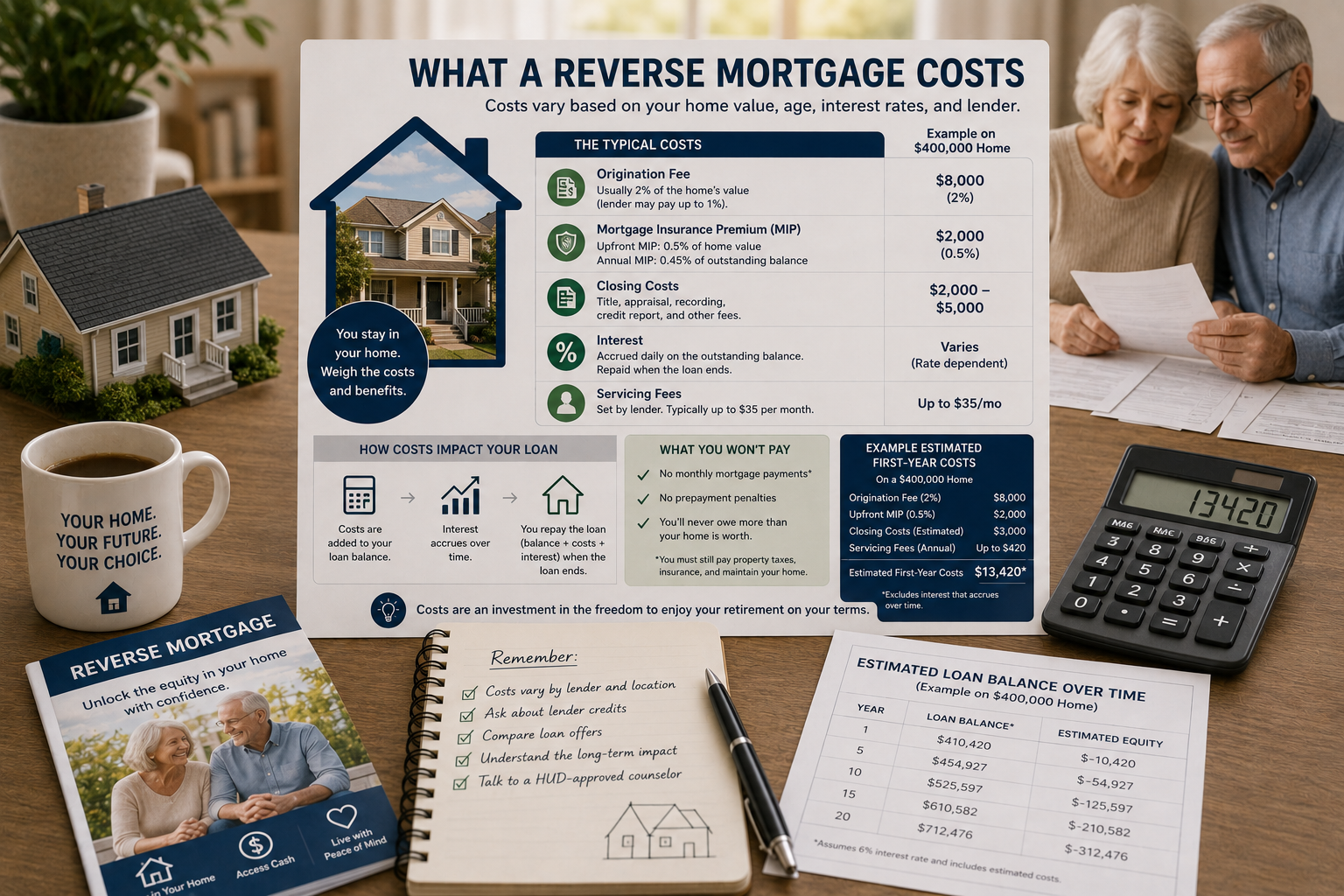
A HECM is generally more expensive to set up than other home loans, though nearly all costs can be financed into the loan (which means they accrue interest over time). The main costs:
- Origination fee, capped by federal formula at 2% of the first $200,000 of the maximum claim amount plus 1% above that, with a floor of $2,500 and a ceiling of $6,000.
- Mortgage insurance premium (MIP), an upfront 2% of the maximum claim amount at closing, plus an annual 0.5% of the outstanding balance. This FHA insurance is what funds the non-recourse guarantee.
- Closing costs, appraisal, title search and insurance, recording, credit report, and similar third-party fees.
- Counseling, the required HUD session typically runs about $125 to $200.
- Servicing fee, a small monthly charge some lenders add.
Because lenders distribute costs differently (a lower rate may come with higher upfront fees, and vice versa), the only fair way to compare is to get itemized quotes for an identical loan amount from several lenders.
What happens to your home and heirs
This is the part families most need to understand. A HECM is non-recourse: neither you nor your heirs will ever owe more than the home is worth. When the last borrower leaves the home, the loan comes due and is usually repaid from the sale. Then:
- If the home sells for more than the balance, the remaining equity goes to you or your heirs.
- If the balance is more than the home’s value, FHA insurance covers the difference, heirs aren’t on the hook.
- To keep the home, heirs can pay the lesser of the loan balance or 95% of the appraised value (the 95% rule).
A qualifying co-borrower spouse can remain in the home for life under a HECM. Protections also exist for an eligible non-borrowing spouse, but they’re narrower, so where possible, both spouses should be co-borrowers.
Pros and cons (and when it’s a good or bad idea)
Pros
- Converts equity to cash with no monthly mortgage payments.
- Lets you age in place rather than sell or move.
- HECM proceeds are loan funds, so they generally don’t affect Social Security or Medicare (means-tested benefits like Medicaid can be affected, plan carefully).
- Non-recourse protection caps what’s owed.
Cons
- Costs are high and the balance grows over time, reducing what you leave to heirs.
- You must keep paying taxes, insurance, and upkeep, falling behind can trigger default and foreclosure.
- Moving out (even to assisted living) for more than 12 months makes the loan due.
- Complexity makes seniors a target for scams.
A reverse mortgage tends to make sense if you have substantial equity, plan to stay in the home long-term, and need income or a cash cushion. It’s usually a poor fit if you may move soon (high costs spread over a short stay), if a spouse or family member who isn’t a borrower needs to remain, or if a cheaper option would meet the need.
How to choose a lender (and avoid scams)
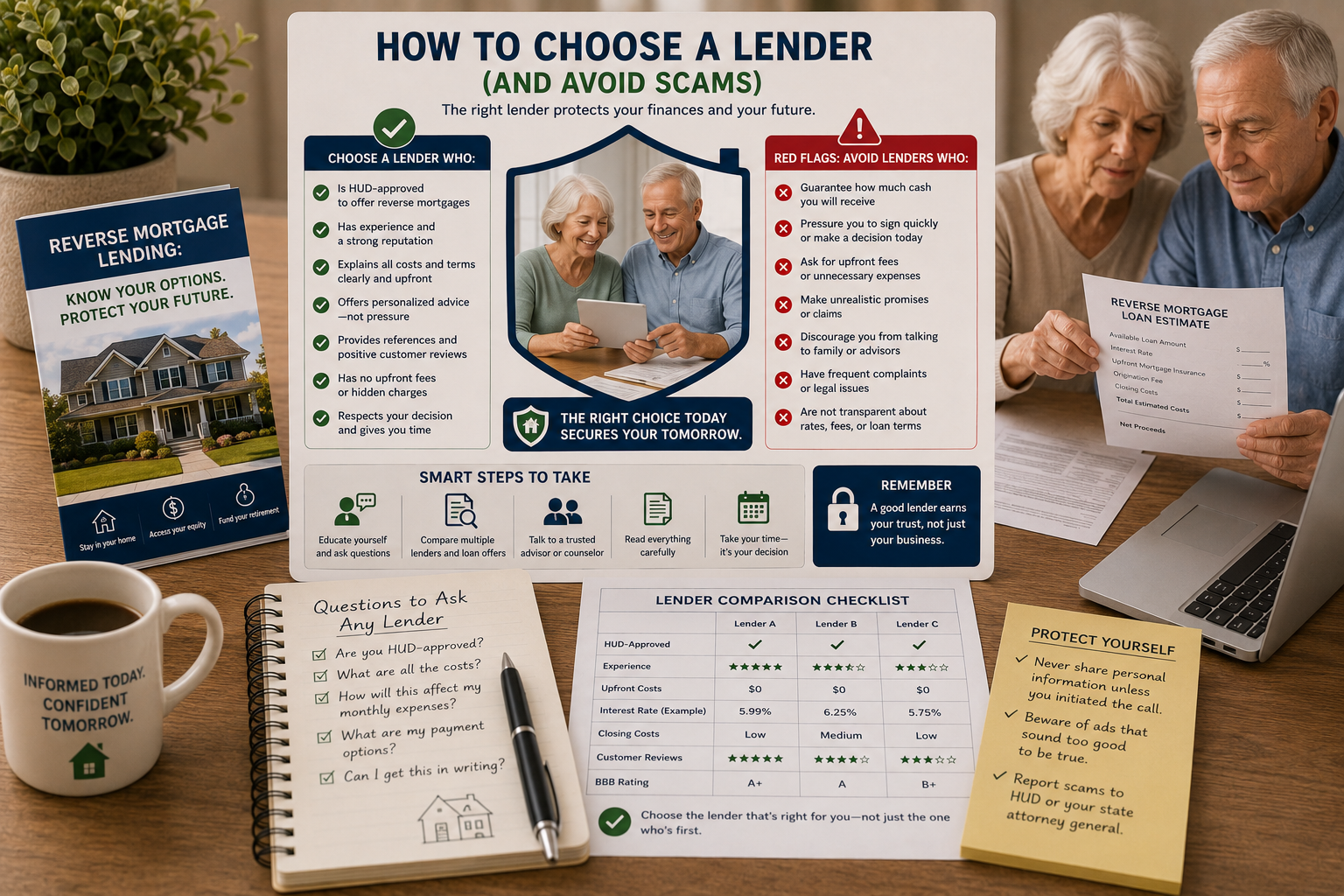
Build a short list, then qualify each lender:
- Confirm the lender is licensed via NMLS Consumer Access, and that an HECM lender is FHA-approved (check HUD).
- Check membership in the National Reverse Mortgage Lenders Association and review the lender’s record in the CFPB complaint database and at the Better Business Bureau, look for trends and how complaints are resolved, not raw counts (bigger lenders get more complaints).
- Get itemized quotes from at least three lenders for the same loan amount, and judge how each treats you: transparency and patience now preview your experience later.
- Red flags: anyone claiming to be from the government, pressure to use proceeds to buy another financial product (annuities, insurance), or rushing you past counseling. The FTC’s reverse-mortgage guidance details common scams. Remember you have a 3-day right of rescission to cancel after closing.
Alternatives to a reverse mortgage
A reverse mortgage isn’t the only way to use home equity or raise cash:
- A home equity loan or HELOC, cheaper to set up, but you make monthly payments and must qualify on income. (Note: since the 2017 tax law, interest is deductible only if the funds are used to buy, build, or substantially improve the home that secures the loan, not for general expenses.)
- Refinancing your existing mortgage over a longer term to lower payments.
- Downsizing, selling and buying something smaller and cheaper to maintain.
- A life settlement, selling a life insurance policy you no longer need.
- A personal loan for smaller, shorter-term needs.
If the goal is to fund care, also weigh long-term care insurance and in-home care options. Whatever the route, talk it through with a trusted, fee-only financial advisor before committing your largest asset.
Reverse mortgage lenders to compare
The reverse-mortgage market has consolidated, so use current, active lenders and get itemized quotes from a few rather than relying on a generic ranking:
- Finance of America Reverse (FAR), the largest reverse lender; also offers HomeSafe jumbo/proprietary loans.
- Mutual of Omaha Mortgage, large, well-known HECM lender.
- Longbridge Financial, HECM and proprietary options.
- Fairway Independent Mortgage (reverse division) and Guild Mortgage (which acquired Cherry Creek), other active national options.
Frequently asked questions
How does a reverse mortgage work?
You borrow against your home equity and receive the money as a lump sum, monthly payments, or a line of credit. You make no monthly mortgage payments; the balance (plus interest and fees) is repaid when the last borrower sells, moves out permanently, or passes away.
How much can you get from a reverse mortgage?
It depends on your age, current interest rates, and home value, capped by the 2026 FHA HECM limit of $1,249,125. Older borrowers and lower rates yield more. The limit is the ceiling used in the calculation, not the amount you receive.
Do you have to pay back a reverse mortgage?
Yes, but not in monthly installments. The full balance comes due when the last borrower leaves the home, usually repaid from the sale.
What happens to a reverse mortgage when you die?
Heirs can sell the home to repay the loan and keep any remaining equity, or keep the home by paying the lesser of the balance or 95% of its appraised value. Because HECMs are non-recourse, heirs never owe more than the home is worth.
Can you lose your home with a reverse mortgage?
Yes, if you stop paying property taxes, homeowners insurance, or upkeep, or move out for more than 12 months. These obligations continue throughout the loan.
What is the age requirement for a reverse mortgage?
For an FHA HECM, the youngest borrower must be at least 62. Some proprietary (jumbo) reverse mortgages accept borrowers as young as 55.
Does a reverse mortgage affect Social Security or Medicare?
No, those benefits aren’t affected because loan proceeds aren’t income. Means-tested programs like Medicaid can be affected, so plan the timing of any draws carefully.
Is a reverse mortgage a good idea?
It can be if you have substantial equity, intend to stay in the home long-term, and need income, but it’s costly and reduces your heirs’ inheritance. Compare it against a home equity loan, refinancing, or downsizing first.
Final thoughts
A reverse mortgage can let you use your home to stay in your home, turning equity into cash with no monthly payments and a non-recourse guarantee. But it’s expensive, it shrinks what you leave behind, and it carries real obligations and scam risk. Understand the 2026 HECM limit and costs, take the HUD counseling seriously, compare itemized quotes from several active, licensed lenders, involve your spouse and heirs, and weigh the alternatives. For related options, see our guides to a home equity loan, life settlement, and the rest of our senior finance guides.

Sharon O'Day - Senior Advisor
Sharon O'Day is the Health editor at Grandfolk, where she commissions and reviews fitness, wellness, and senior-care content for accuracy, clarity, and real-world usefulness. At 60-plus, she writes for older adults from lived experience, testing the advice against the questions she and her peers actually ask. She focuses on guidance that is honest about both the benefits and the limits, and that always points readers back to their own doctor for personal decisions.