
Home Equity Loan Guide 2026: Rates, HELOC vs. Loan & Costs
Last Reviewed: June 2026 | By Sharon O’Day, Senior Advisor | Fact-checked by the Grandfolk Editorial Team





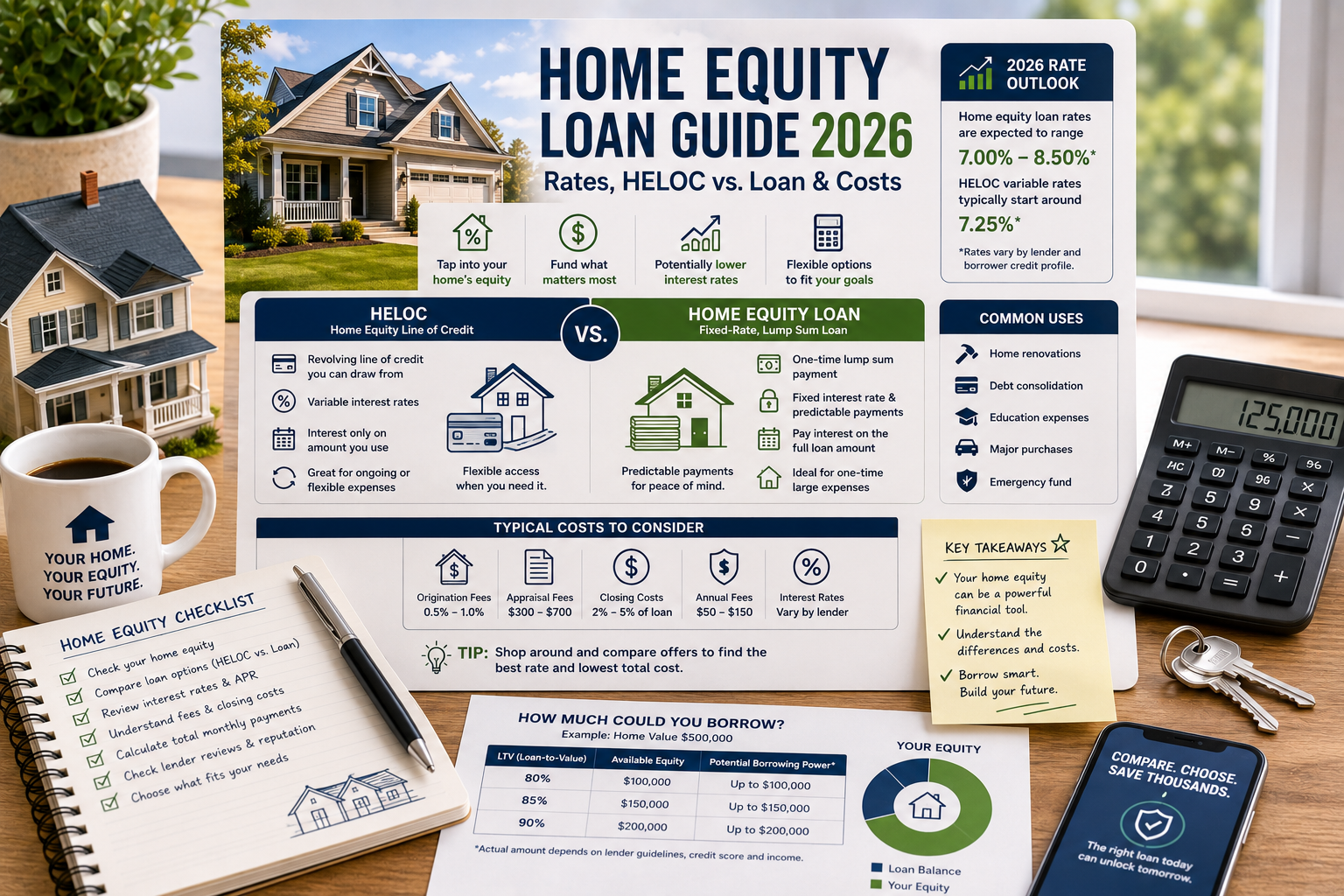
The leaking roof isn’t covered by insurance. The aging car has to be replaced. Years of small charges have left high-interest credit card balances that are busting the budget. These demands tend to arrive when we can least afford them, and for many retirees the largest store of value they can turn to is the home they’ve spent decades paying down. A home equity loan is one way to convert some of that value into cash, at a far lower interest rate than credit cards, without selling or moving, as long as you use it carefully and don’t put the home at unnecessary risk.
What is a home equity loan?
Roughly half the net worth of the typical American household is tied up in home equity, the difference between your home’s market value and what you still owe on it. A home equity loan (sometimes called a second mortgage) lets you borrow a fixed lump sum against that equity, at a fixed interest rate, repaid in fixed monthly payments over a set term (commonly 5 to 30 years). You keep the title and full ownership; you simply add a second loan secured by the home. Because the home is collateral, the rate is much lower than unsecured borrowing, but missed payments can put the home at risk.
The three ways to tap your home equity
Home equity loans are one of three main options, and they suit different needs:
Home equity loan (lump sum, fixed rate)
Best when you need a specific, one-time amount and want predictable payments, a known repair bill, a debt consolidation, a single project. You get the money up front and the rate never changes.
HELOC (revolving line of credit, usually variable)
A home equity line of credit works like a credit card secured by your home: the lender approves a limit, you draw what you need during a draw period (often 10 years), and you pay interest only on what you’ve used, typically at a variable rate, before a repayment period (often 20 years) begins. Best for ongoing or unpredictable needs (a series of projects, an emergency cushion). The trade-off is that payments can rise if rates rise.
Cash-out refinance
This replaces your existing first mortgage with a larger one and pays you the difference in cash. It can offer the most money, but it resets your primary mortgage, rarely worth it if you’re sitting on a low first-mortgage rate. (If you’re 62+ and want to tap equity without monthly payments, a reverse mortgage is a separate option with very different mechanics.)
How much can you borrow? (equity, LTV, and requirements)
Lenders cap how much of your equity you can borrow using a combined loan-to-value (CLTV) limit, usually up to about 80 to 85% of your home’s value across all loans secured by it. In practice:
- Take your home’s value, multiply by ~0.85, subtract your existing mortgage balance, that’s roughly your borrowing ceiling.
- You’ll generally need at least 15 to 20% equity remaining, a credit score around 620+ (the best rates go to scores in the high 600s to 700s+), a manageable debt-to-income ratio, and verifiable income to repay.
The amount actually offered is often well below the maximum, based on your income and credit.
Home equity loan rates in 2026
Rates change constantly, so treat any figure as a snapshot and confirm today’s numbers. As of mid-2026, the national average home equity loan rate is roughly 8%, and the average HELOC rate is roughly 7.5% (per Bankrate and other lender surveys). That’s well below the ~20%+ typical of credit cards and the ~12% typical of personal loans, which is why home equity borrowing is often the cheapest way for a homeowner to access a large sum. A home equity loan’s rate is fixed; a HELOC’s is usually variable, so a HELOC can start lower but rise over time.
What a home equity loan costs
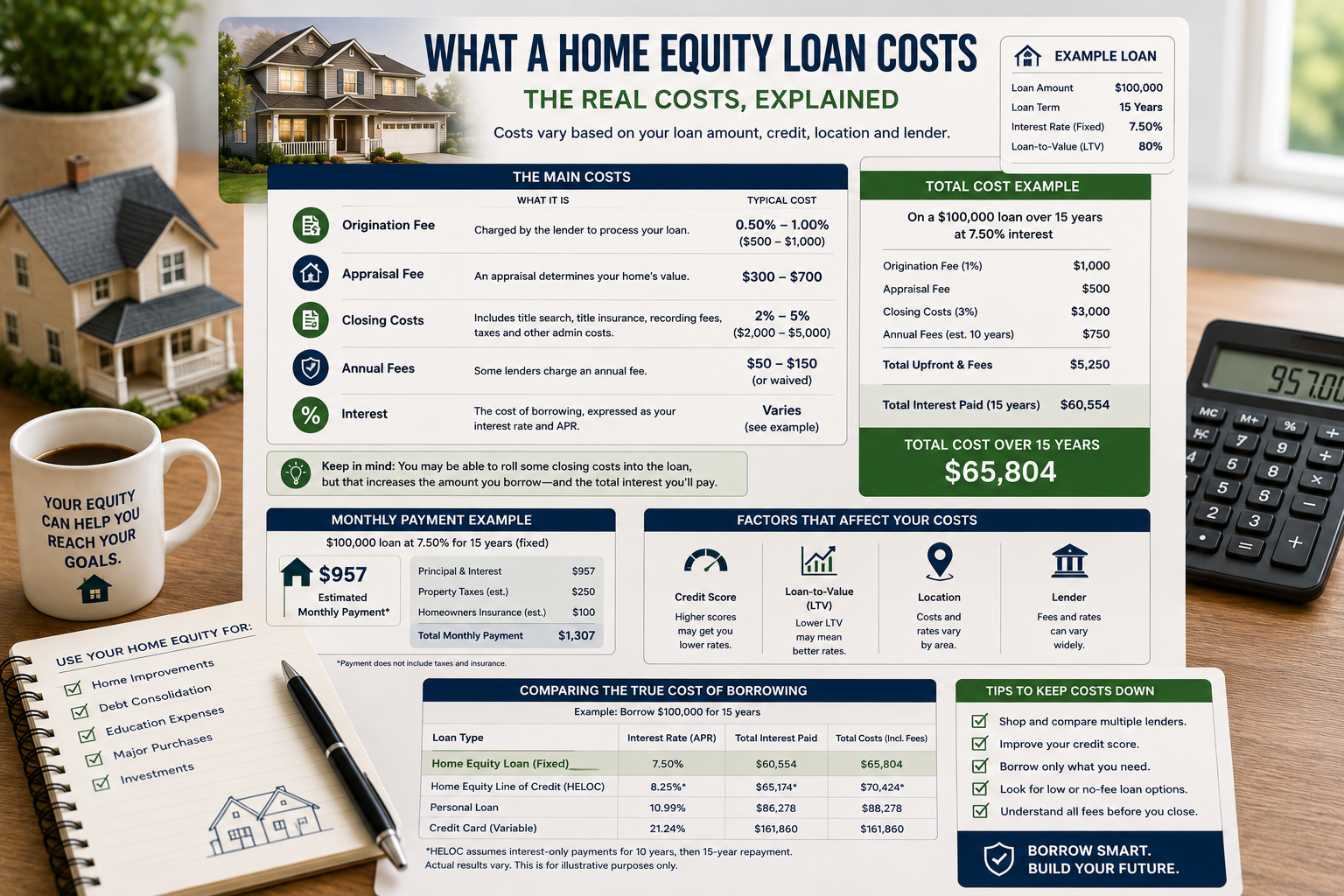
The interest rate isn’t the whole cost. Compare the APR (which folds in fees) and watch for:
- Application / processing fee (often around $100, sometimes refunded if denied).
- Appraisal fee to establish your home’s value (ask if a cheaper valuation method is acceptable).
- Origination / underwriting fee (commonly 0 to 2% of the loan).
- Document preparation and recording fees.
- Broker fee if you use one (avoidable by going directly to lenders).
- Hidden terms, read the fine print for prepayment penalties or balloon payments.
The fairest comparison is identical proposals (same amount, same term) from two or three lenders, judged on APR and monthly payment.
Is the interest tax-deductible?
Sometimes, but the rule is narrower than many people assume. Under current law, interest on a home equity loan or HELOC is deductible only if you use the funds to buy, build, or substantially improve the home that secures the loan, and only within the overall mortgage-debt limits. Using the money for other purposes (debt consolidation, a car, living expenses) generally means the interest is not deductible. See the IRS guidance and confirm specifics with a tax professional.
Pros and cons (and good vs. poor uses)
Pros
- Much lower rates than credit cards or personal loans.
- Fixed, predictable payments (home equity loan) and lump-sum certainty.
- Lets you consolidate high-interest debt or fund a large need without disrupting a low first-mortgage rate.
Cons
- Your home is collateral, default can lead to foreclosure.
- Closing costs and fees add up.
- It converts unsecured debt into secured debt when used to pay off cards, cheaper, but now your home is on the line.
Good uses tend to be one-time, value-preserving, or rate-reducing: a necessary repair, a medical bill, or consolidating high-interest debt you have a real plan to pay off. Poor uses are discretionary spending or treating the home like a piggy bank, a habit that left many homeowners exposed when prices fell in 2008.
How to choose a lender (and your right to cancel)
- Identify 4 to 5 reputable, regulated lenders (your bank, a credit union, an established mortgage lender), then narrow to the best three quotes.
- Compare on APR, term, and monthly payment, and confirm fixed vs. variable.
- Don’t be talked into a larger loan than you need, or into add-on products that inflate the cost.
- You never have to turn over the deed to get a loan; if anyone asks, walk away.
- You have a 3-day right of rescission under the Truth in Lending Act when you pledge your home (except on a primary-mortgage purchase), the lender must give you a cancellation form at signing. The CFPB and the Federal Reserve’s HELOC guide are good neutral references.
Watch out for scams
The home equity space has long attracted predatory operators who target older homeowners, sometimes leaving victims without a home. Read closing papers carefully, question anything that looks altered or added, and be wary of pressure tactics or fees buried in the fine print. The FTC’s home-equity guidance details common scams; if something feels wrong, contact your state attorney general’s office or the FTC before signing.
Home equity lenders to compare

Get itemized quotes from a few current, active lenders rather than relying on a generic ranking:
- U.S. Bank, TD Bank, PNC, Regions, Navy Federal (members), established banks/credit unions offering home equity loans and HELOCs.
- Discover, Spring EQ, Figure, active home-equity specialists/online lenders.
- Marketplaces like LendingTree or Bankrate, to compare multiple offers at once.
Frequently asked questions
What are current home equity loan rates?
As of mid-2026, home equity loans average around 8% and HELOCs around 7.5%, well below credit cards (~20%+) and personal loans (~12%). Rates change often, so confirm today’s figures and shop at least three lenders.
How much can I borrow with a home equity loan?
Usually up to a combined loan-to-value of about 80 to 85% of your home’s value, minus your existing mortgage balance. You’ll typically need 15 to 20% equity remaining, plus qualifying credit and income.
What’s the difference between a home equity loan and a HELOC?
A home equity loan gives you a fixed lump sum at a fixed rate with set payments. A HELOC is a revolving line of credit you draw from as needed, usually at a variable rate. Loans suit one-time needs; HELOCs suit ongoing ones.
Is home equity loan interest tax-deductible?
Only if you use the funds to buy, build, or substantially improve the home that secures the loan, within mortgage-debt limits. Interest on funds used for other purposes generally isn’t deductible. Confirm with a tax professional.
What credit score do I need for a home equity loan?
Generally around 620 or higher, with the best rates going to scores in the high 600s to 700s and above, along with sufficient equity and income.
Can I get a home equity loan on a paid-off house?
Yes. With no existing mortgage, your full equity is available up to the lender’s CLTV limit, which can make approval easier.
Can I lose my home with a home equity loan?
Yes. The home is collateral, so missed payments can lead to foreclosure. Only borrow what your budget can comfortably repay.
Is a home equity loan a good idea?
It can be for a one-time need or to consolidate high-interest debt at a much lower rate, if you have a repayment plan. It’s a poor idea for discretionary spending, since you’re putting your home at risk.
Final thoughts
A home equity loan can be one of the cheapest ways for a homeowner to borrow a large sum, with fixed, predictable payments, but it puts your home on the line, so it’s worth doing carefully. Understand the difference between a home equity loan, a HELOC, and a cash-out refinance; confirm current rates and borrow only what you need; compare APRs and fees across three lenders; know the narrow tax rules; and use your 3-day right to cancel if something feels off. For related options, see our guides to a reverse mortgage, debt consolidation loans, and the rest of our senior finance guides.

Sharon O'Day - Senior Advisor
Sharon O'Day is the Health editor at Grandfolk, where she commissions and reviews fitness, wellness, and senior-care content for accuracy, clarity, and real-world usefulness. At 60-plus, she writes for older adults from lived experience, testing the advice against the questions she and her peers actually ask. She focuses on guidance that is honest about both the benefits and the limits, and that always points readers back to their own doctor for personal decisions.