
Medicare Supplement Insurance (Medigap): 2026 Plans & Costs
Last Reviewed: June 2026 | By Sharon O’Day, Senior Advisor | Fact-checked by the Grandfolk Editorial Team






Few decisions shape a senior’s later years more than how they handle Medicare. Original Medicare (Parts A and B) covers roughly 80% of approved medical costs – but it leaves the other 20% with no annual cap, so one serious illness or accident can mean financially devastating bills. Medicare Supplement insurance – Medigap – exists to fill those gaps. And the single most important thing to know is timing: your one-time Medigap Open Enrollment Period around your 65th birthday is when no insurer can turn you down or charge more for your health. Get that first decision right, because changing later isn’t always guaranteed.
What is Medigap, and how does it work with Original Medicare?
Once you’re enrolled in Medicare Part B, you have three broad paths:
- Do nothing extra and pay out of pocket for whatever Original Medicare doesn’t cover;
- Choose a Medicare Advantage (Part C) plan from a private insurer that bundles your coverage, usually with networks and referrals; or
- Keep Original Medicare and add a Medigap policy that pays many of the gaps – coinsurance, copayments, and deductibles.
With Medigap, Medicare pays its share of an approved service first, then your Medigap policy pays its share directly to the provider. How much it picks up depends on which lettered plan you choose – and the more it covers, the higher the premium. Note that Medigap does not include prescription drugs; you’ll pair it with a separate Part D drug plan.
A useful way to think about it: because the benefits of each lettered plan are set by the government, Medigap is almost a straight accounting function – the insurer doesn’t decide what’s covered or which doctor you see. Medicare decides that; Medigap just helps pay what Medicare doesn’t.
Medigap vs. Medicare Advantage: a quick comparison
| Medigap (+ Original Medicare + Part D) | Medicare Advantage (Part C) | |
|---|---|---|
| Doctors | Any provider in the U.S. who accepts Medicare | Network-based; referrals often required |
| Out-of-pocket | Very predictable; little to nothing after the deductible (Plan G) | Copays/coinsurance up to a yearly max |
| Drugs | Separate Part D plan | Usually included |
| Extras (dental/vision) | Not included | Often bundled |
| Premium | Higher (plus Part B and Part D) | Often low or $0 (plus Part B) |
Neither is better universally – Medigap favors freedom of provider and predictable costs; Advantage favors lower premiums and bundled extras with more rules.
The standardized Medigap plans (and why Plan F is closing)
There are ten standardized plans, labeled A through N (Massachusetts, Minnesota, and Wisconsin standardize differently). Every plan of a given letter offers identical benefits no matter which company sells it – only the price and service differ. You can see exactly what each covers in the official Medicare plan-comparison table.
One change trips up many new enrollees: under a 2015 law (MACRA), Plans C and F are no longer available to anyone who became eligible for Medicare on or after January 1, 2020, because they covered the Part B deductible. If you were eligible before 2020 you can keep or switch into them; if you’re newly turning 65, you cannot buy Plan F – so any older advice to just get Plan F no longer applies. For new enrollees, the decision now centers on three plans:
Plan G – the most comprehensive plan for new enrollees
Plan G covers every gap except the annual Part B deductible ($283 in 2026). After you pay that small deductible, it covers your Part B 20% coinsurance, the Part A hospital deductible ($1,736 in 2026), skilled-nursing coinsurance, hospice copays, the first three pints of blood, foreign-travel emergencies, and Part B excess charges. It’s now the most popular plan for people new to Medicare.
Plan N – lower premium, small copays
Plan N works like Plan G but trades a lower premium for small copays (up to $20 for office visits and up to $50 for ER visits that don’t lead to admission), and it does not cover Part B excess charges. A good fit if you see doctors who accept Medicare assignment and want to save on premium.
High-Deductible Plan G – lowest premium
Same benefits as Plan G, but you pay a higher annual deductible – $2,950 in 2026 – before coverage begins, in exchange for a much lower monthly premium. It suits healthy, budget-focused enrollees comfortable managing upfront costs, since it caps your annual Medicare cost-sharing once the deductible is met.
What Medigap does and doesn’t cover
Medigap helps with Medicare cost-sharing for services Medicare approves, as long as your provider accepts Medicare assignment (agrees to Medicare’s approved rates) – confirm this with each new provider. It generally does not cover:
- Prescription drugs (use a separate Part D plan – see prescription delivery)
- Long-term care (nursing-home custodial care)
- Dental, vision, and hearing aids
- Private-duty nursing
Those gaps remain your responsibility unless you buy separate coverage.
When to enroll: your Medigap Open Enrollment Period
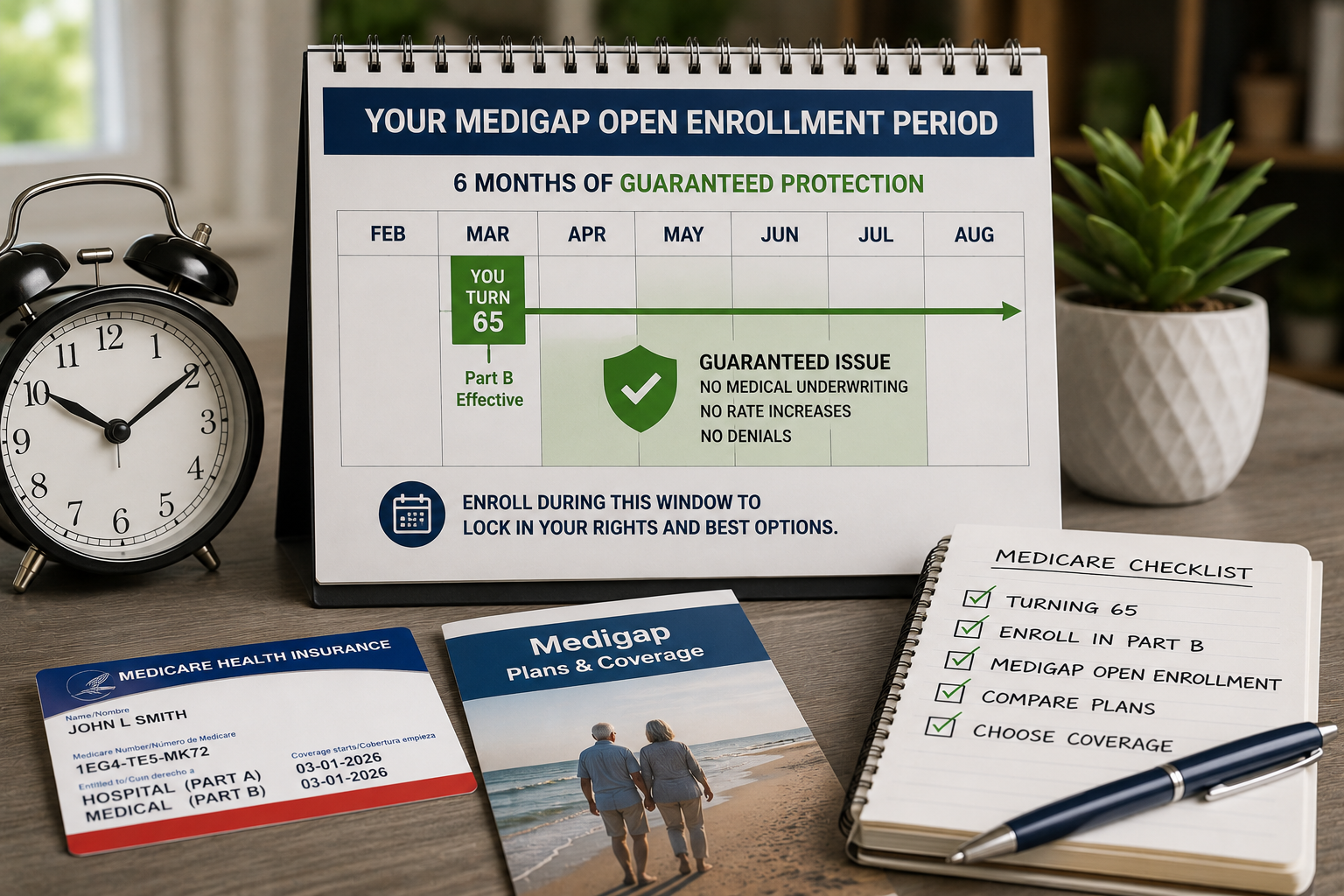
This is the most important window in Medigap. Your 6-month Open Enrollment Period begins the first month you’re both 65 and enrolled in Part B. During it, you have guaranteed issue rights: insurers can’t deny you, charge more, or impose underwriting because of your health or pre-existing conditions.
Apply at any other time and the insurer can require medical underwriting, charge more, deny you, or delay coverage of a pre-existing condition for up to six months. There are some guaranteed-issue exceptions later – for example, if you lose other coverage or a Medicare Advantage trial doesn’t work out – but you’re far better off getting the first choice right. (You can apply for a change without dropping your current policy, so you have a fallback if you’re declined.)
How much does Medigap cost in 2026?
Your total cost is the Medigap premium plus your monthly Part B premium (and a Part D premium for drugs). Because benefits are standardized, the smart move is an apples-to-apples price comparison of the same lettered plan across insurers. Plan G premiums commonly run on the order of $100–$200 a month, varying by your state, ZIP code, age, gender, and tobacco use – and by how the insurer prices premiums, which matters more than most people realize.
How insurers price premiums (community / issue-age / attained-age)
This is the detail few buyers ask about – and it can cost or save you thousands over time. There are three methods (some states mandate which insurers may use, so ask about your state):
- Community-rated: everyone pays the same premium regardless of age. A 65-year-old and a 77-year-old pay the same for that plan. Often the most attractive long-term, though it can cost more in the early years.
- Issue-age-rated: the premium is set by your age when the policy is issued and doesn’t rise because you age (it still rises with inflation). A reason not to switch later if you can avoid it.
- Attained-age-rated: starts low when you’re younger but rises every year as you age – usually the most expensive over time.
All else equal, community-rated is generally the most attractive – choose it if it’s available with the plan and insurer you want.
How to choose and price-shop a policy
- Decide how much of the gap you want covered, which points you to Plan G, N, or High-Deductible G.
- See which insurers offer that plan in your state with Medicare.gov’s Medigap finder.
- Get apples-to-apples quotes for that exact plan from several reputable insurers, and ask each about its pricing method and any discounts (nonsmoker, married/household, paying annually, electronic funds transfer).
- Favor financially strong, well-known insurers – check the company’s rating at A.M. Best; stronger insurers tend to pay claims faster and raise rates less.
- Buy directly from the insurer or through a licensed broker. (Remember: all standardized plans are guaranteed renewable – the insurer can’t drop you for health reasons as long as you pay and were honest on your application.)
Where to get unbiased help

Every state runs a free State Health Insurance Assistance Program (SHIP) that offers one-on-one Medicare counseling with no sales agenda – find yours at shiphelp.org. For a deep reference, Medicare’s free guide Choosing a Medigap Policy is the authoritative starting point.
Frequently asked questions
Is Plan F still available?
Only to people who became eligible for Medicare before January 1, 2020. If you’re newly eligible on or after that date, you can’t buy Plan F or Plan C – Plan G is the most comprehensive option available to you.
What’s the best Medigap plan?
For most new enrollees, Plan G offers the most complete coverage; Plan N trades small copays for a lower premium; and High-Deductible Plan G offers the lowest premium with a $2,950 (2026) deductible. The best depends on your budget and how predictable you want costs to be.
How much does Medicare Supplement insurance cost?
Plan G premiums commonly run about $100–$200 a month, plus your Part B (and Part D) premiums. Price varies by plan, insurer, location, age, gender, tobacco use, and the insurer’s pricing method.
What does Medigap not cover?
Prescription drugs (use Part D), long-term care, dental, vision, hearing aids, and private-duty nursing.
Can I be denied a Medigap policy?
Not during your 6-month Open Enrollment Period at 65, when coverage is guaranteed. Outside that window (and outside specific guaranteed-issue situations), insurers can use medical underwriting and may deny you or charge more.
Does Medigap cover prescription drugs?
No. You’ll need a separate Medicare Part D drug plan.
What’s the difference between Plan G and Plan N?
Both are comprehensive, but Plan N has a lower premium in exchange for small office and ER copays and doesn’t cover Part B excess charges, while Plan G covers both.
Should I choose Medigap or Medicare Advantage?
Medigap offers any-doctor access and very predictable costs at a higher premium; Medicare Advantage offers low premiums and bundled extras with networks and referrals. The right choice depends on your priorities and health.
Final thoughts
Medigap turns Original Medicare’s open-ended 20% into something predictable. For new enrollees, the real decision is Plan G vs. Plan N vs. High-Deductible Plan G – Plan F is no longer on the table. Enroll during your Open Enrollment Period while coverage is guaranteed, compare the same plan across several financially strong insurers, pay attention to the pricing method, and lean on your free SHIP counselor if you want unbiased help. For the coverage Medigap leaves out, see our guides to long-term care insurance, dental insurance, and the rest of our senior insurance guides.

Sharon O'Day - Senior Advisor
Sharon O'Day is the Health editor at Grandfolk, where she commissions and reviews fitness, wellness, and senior-care content for accuracy, clarity, and real-world usefulness. At 60-plus, she writes for older adults from lived experience, testing the advice against the questions she and her peers actually ask. She focuses on guidance that is honest about both the benefits and the limits, and that always points readers back to their own doctor for personal decisions.