
How to Buy Gold: A Complete Guide for Beginners and Seniors
Last Reviewed: June 2026 | By Sharon O’Day, Senior Advisor | Fact-checked by the Grandfolk Editorial Team






Gold has been a store of value for thousands of years, and interest in owning it tends to rise whenever the economy feels uncertain. In 2026 that interest is especially high: gold set a record near $5,602 per ounce in January 2026 before settling into the $4,100–$4,200 range by mid-year. But buying physical gold is more involved than placing an order, and the precious-metals market attracts both reputable dealers and outright scammers. This guide explains, in plain language, how gold pricing works, the forms you can buy, what it really costs, how to choose a trustworthy dealer, how to store it, the tax rules, and the warning signs every buyer – especially retirees – should know before spending a dollar.
This article is educational and is not personalized financial advice. Speak with a fiduciary financial advisor and a tax professional before making investment decisions.
Why people buy gold – and the honest pros and cons
Many people own gold for peace of mind. It is portable, widely recognized, and trades in a structured global market, which is why it is often described as a hedge against inflation, currency weakness, or geopolitical shocks. During the 2008 financial crisis and again during the uncertainty of the 2020s, demand for gold climbed.
It helps to be clear-eyed, though. Gold is not a one-way bet:
- Pros: tangible asset you can hold; long history as a store of value; diversifies a portfolio that’s heavy in stocks and bonds; highly liquid in standard bullion forms.
- Cons: produces no interest or dividends; the price can fall sharply and stay down for years; storage and insurance add cost; physical gold can be lost or stolen.
Because gold generates no income, most advisors treat it as insurance rather than a growth engine, and suggest keeping any allocation modest. For a balanced overview of gold’s role in a portfolio, the World Gold Council is a useful research source.
The forms of gold you can buy
Bullion coins
Government-minted bullion coins are the most popular way for individuals to own gold. The most liquid one-ounce coins include the American Gold Eagle and American Buffalo (see the U.S. Mint), the Canadian Gold Maple Leaf, and the South African Krugerrand. Their value comes from their metal content, the reputation of the mint, and – for some – collectibility.
Gold bars and rounds
Bars (ingots) range from one gram up to 100 troy ounces or more. One-ounce bars from respected refiners such as PAMP Suisse, Valcambi, or the Royal Canadian Mint are typically .9999 fine (four nines), assayed, serial-numbered, and sealed. The larger the bar, the lower the premium per ounce – but larger pieces are harder to sell in part.
Collectible (numismatic) coins – be careful here
Rare or semi-numismatic coins are sold on the promise of collector value, but they carry high markups and are usually less liquid than plain bullion. Federal regulators warn that fraudsters often push collectible coins to justify inflated prices. If you are buying gold as an investment rather than as a hobby, standard bullion is generally the simpler, more transparent choice.
Gold ETFs, funds, and mining stocks
If you don’t want to handle or store metal, gold-backed exchange-traded funds (ETFs) track the gold price and trade like stocks through a broker. You own a security rather than physical gold, which suits some investors and disappoints others who want the metal in hand. Mining stocks are a different bet – they track companies, not just the metal.
How gold pricing works: spot price plus premium
Two numbers determine what you pay:
- Spot price – the live global market price for one troy ounce of gold, quoted in U.S. dollars and updated continuously during market hours. You can watch it on trackers such as Kitco.
- Premium – the dealer’s markup over spot, covering minting, handling, shipping, and margin. Premiums are lower per ounce on larger pieces and higher on small or collectible items.
A simple worked example
If the spot price is $4,150/oz and a dealer charges a 4% premium on a one-ounce coin, the coin costs roughly $4,150 + $166 = $4,316. Because spot moves by the second, a good dealer lets you lock your price at checkout and shows transparent bid (buy-back) and ask (purchase) prices. Always compare identical items across dealers and pay the lowest total premium.
The real costs and fees of buying gold
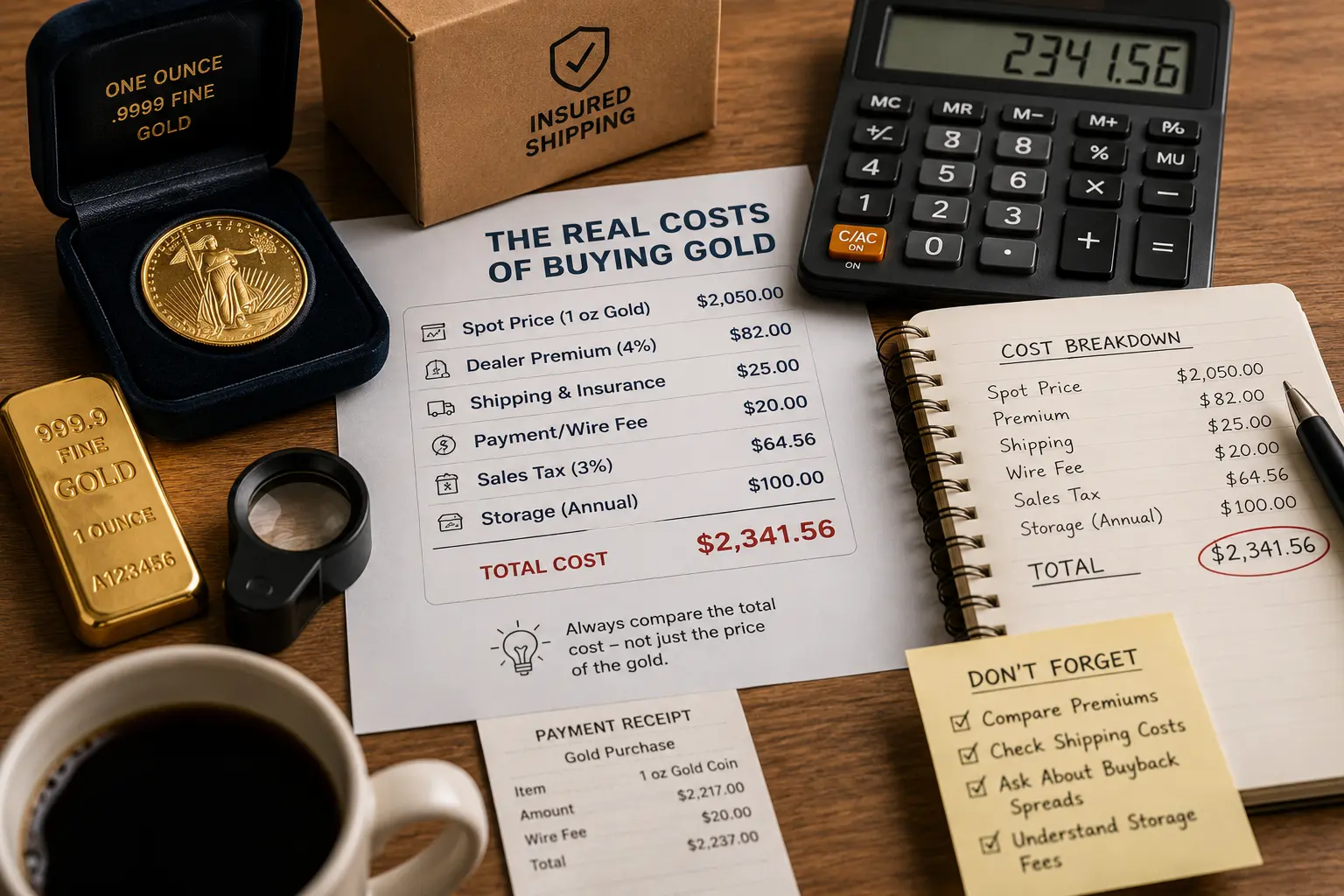
Beyond spot + premium, watch for:
- Shipping and insurance – some dealers offer free shipping above a minimum; otherwise it can meaningfully reduce the value of a small purchase.
- Wire-transfer fees – large orders are often paid by bank wire; your bank and the dealer may each charge.
- State sales tax – some states tax bullion; many exempt it. Factor this into the total.
- Storage fees – if a dealer or depository stores your gold, expect a fee by weight or a flat monthly amount.
- Buy-back spread – the gap between what you pay and what you’d receive selling back. Ask for it before you buy.
How to choose a trustworthy gold dealer
Trust is everything, because you typically send money before metal arrives. Look for a dealer that:
- Displays transparent, live pricing and lets you lock your price;
- States all premiums and fees in writing before you commit;
- Publishes a clear buy-back policy and spread;
- Has a long track record and genuine, verifiable third-party reviews (e.g., BBB, Trustpilot);
- Ships in insured, discreet packaging with tracking;
- Does not use high-pressure sales or act now tactics.
The U.S. Commodity Futures Trading Commission’s checklist, 10 Things to Ask Before Buying Physical Gold, is an excellent vetting tool – including the tip to multiply the metal’s weight by the current spot price and compare it to the price you’re being quoted.
How to make your first purchase, step by step
- Decide the form and amount – e.g., one-ounce bullion coins or bars.
- Compare total cost across two or three reputable dealers (spot + premium + shipping).
- Lock your price at checkout and complete payment within the dealer’s window.
- Choose insured – or arranged depository storage.
- Verify on delivery – check serial numbers, assay cards, and packaging seals.
- Store it securely and keep your purchase documentation.
How to store physical gold safely
There are three common options, each with trade-offs:
- Home safe – immediate access, but you’re responsible for security and insurance; keep its existence private.
- Bank safe deposit box – secure and inexpensive, but contents usually aren’t FDIC-insured and access is limited to bank hours.
- Insured depository – a professional facility offering allocated (your specific metal) or segregated storage with full insurance, for a fee.
Important: gold held inside an IRA must be stored at an IRS-approved depository – you cannot legally keep IRA gold at home.
Putting gold in an IRA – the basics and the warnings
A self-directed IRA can hold physical gold, but it comes with rules and costs. Only certain bullion qualifies (most IRA-eligible gold must meet a minimum fineness, generally .995, with specific government coins like the American Gold Eagle permitted by statute), and it must be held by an approved custodian at an approved depository, with administrative, storage, and insurance fees.
Regulators flag gold IRAs as a frequent target for abuse. In one case the CFTC cited, a dealer charged nearly $150,000 in fees and commissions on a $300,000 IRA rollover. Never let a salesperson rush you into a rollover, and confirm the rules with a tax professional and the IRS.
Taxes when you buy and sell gold
The IRS treats physical gold as a collectible. That means long-term gains can be taxed at a maximum rate of 28% – higher than the top long-term rate on most stocks. Short-term gains are taxed as ordinary income. Some states also charge sales tax at purchase. Tax situations vary, so confirm the specifics with a qualified tax professional before you buy or sell.
How to avoid gold-buying scams
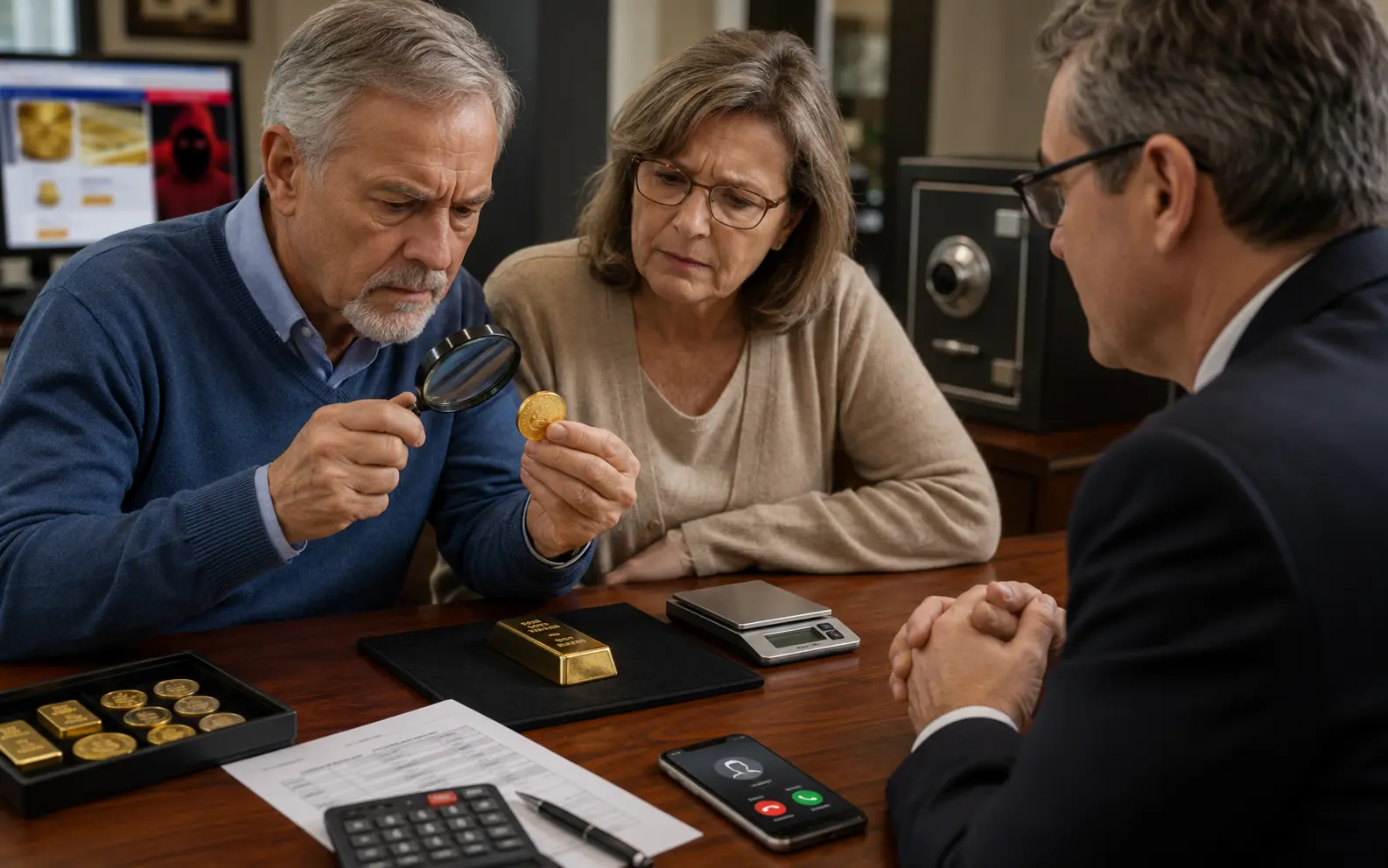
This matters more than any other section. Regulators have repeatedly charged precious-metals dealers with frauds that specifically targeted older adults – including a $185 million scheme and a $68 million scheme, both aimed at the elderly, with markups running 100%–300% over market price. Protect yourself by watching for these warning signs from the CFTC’s precious-metals fraud advisory:
- Unsolicited calls, emails, mailers, or late-night ads promising big, low-risk profits.
- High-pressure once-in-a-lifetime pitches that rush you to decide.
- Offers to finance a metals purchase so you control more with a small down payment.
- Salespeople posing as IRA experts pushing you to move retirement savings.
- Pressure to buy collectible coins at large markups instead of standard bullion.
- Claims that the company will buy and store the metal for you, with vague paperwork.
Before paying anyone, check the dealer with your state attorney general or securities regulator (the NASAA Senior Investor Resource Center can help), get every fee in writing, and never act on a cold call.
Gold dealers to research
Advertiser disclosure: Grandfolk may earn a commission when you use links to some partners. Compensation never determines what we recommend – always do your own due diligence and compare total cost.
The dealers below are established names worth researching. Compare each one’s live pricing, premiums, buy-back spread, and independent reviews before deciding.
| Dealer | What to check | Full review |
|---|---|---|
| APMEX | Live pricing, premium on 1-oz coins, shipping threshold, buy-back spread | Read our APMEX review |
| American Gold Exchange | Minimum order, premiums, return window, buy-back terms | Read our American Gold Exchange review |
| Goldline | Pricing transparency, fees, independent reviews | Read our Goldline review |
| Monex | Product range, purity guarantees, storage options | Read our Monex review |
| Rosland Capital | Coin grading/verification, fees, IRA terms | Read our Rosland Capital review |
Frequently asked questions
Is gold a good investment for retirees?
Gold can diversify a portfolio and act as a store of value, but it pays no income and can fall in price. Most advisors treat it as a modest, defensive holding rather than a primary income source. Discuss your situation with a fiduciary financial advisor.
How much gold should I own?
There’s no single right answer. Many financial professionals suggest keeping any precious-metals allocation small relative to your overall portfolio so a price drop won’t jeopardize your retirement. A fee-only advisor can help you decide what fits your goals.
Is it better to buy gold coins or bars?
One-ounce government bullion coins are the most liquid and easiest to resell. Bars carry lower premiums per ounce in larger sizes but are harder to sell in part. For most individual buyers, recognizable one-ounce coins are the simplest starting point.
Where is the safest place to store gold?
A quality home safe, a bank safe deposit box, or an insured depository each work, with trade-offs in cost, access, and insurance. Gold held in an IRA must be stored at an IRS-approved depository.
Do I pay taxes when I sell gold?
Yes. The IRS treats physical gold as a collectible, so long-term gains can be taxed up to 28%, and some states charge sales tax at purchase. Confirm the details with a tax professional.
How do I avoid getting scammed when buying gold?
Ignore unsolicited offers and high-pressure pitches, avoid financed or leveraged metal purchases, compare your quoted price against the live spot price, get all fees in writing, and verify the dealer with your state regulator before paying.
The bottom line
Buying gold can be a sensible way to diversify and protect savings – if you go in informed. Stick to recognizable bullion from transparent, reputable dealers, understand the spot-plus-premium pricing, plan for storage and taxes, and treat any unsolicited, high-pressure offer as a red flag. Do that, and you’ll be buying gold the safe way rather than the expensive way. When you’re ready, compare a few established dealers above and read our full reviews before you commit.

Sharon O'Day - Senior Advisor
Sharon O'Day is the Health editor at Grandfolk, where she commissions and reviews fitness, wellness, and senior-care content for accuracy, clarity, and real-world usefulness. At 60-plus, she writes for older adults from lived experience, testing the advice against the questions she and her peers actually ask. She focuses on guidance that is honest about both the benefits and the limits, and that always points readers back to their own doctor for personal decisions.