
Boat Insurance Guide 2026: What It Costs & What It Covers
Last Reviewed: June 2026 | By Sharon O’Day, Senior Advisor | Fact-checked by the Grandfolk Editorial Team






Retirement is when a lot of people finally get to enjoy their boat the way they always wanted longer trips, weekday mornings on the water, no Monday deadline to race back for. Whether you’ve owned boats for decades or you’re buying your first one off the bucket list, one budget line matters more than it looks: boat insurance. Leaning on a homeowners policy rarely provides enough protection, and being underinsured in a liability claim can put the rest of your retirement savings at risk.
The good news is that boat insurance is usually more affordable than people expect. Liability-only coverage commonly runs $200-$500 a year, and full (comprehensive) coverage averages about 1.5% of your boat’s value per year roughly $300 a year for a $20,000 boat. Here’s how it works and how to choose a policy.
What is boat insurance (and does homeowners insurance cover a boat)?
Boat insurance is a policy that protects your watercraft, your liability to others, and the people aboard. It works a lot like car insurance: you’ll see familiar coverages like collision, comprehensive, bodily injury, medical payments, and uninsured/underinsured boater plus some marine-specific protections you won’t find on an auto policy.
A homeowners insurance policy may extend limited coverage to a small, low-value boat (think a canoe or a small sailboat), and sometimes you can add an endorsement. But it usually won’t cover larger or motorized boats, and it rarely covers liability the damage your boat could do to other people, their boats, or their property. That liability gap is the single biggest reason boaters carry a dedicated policy. Boat policies typically let you buy $15,000 to $300,000+ in liability coverage, and higher limits (often $500,000-$1,000,000) are worth considering if you operate a larger or faster boat.
Do you need boat insurance? Legal, marina, and lender requirements
Boat insurance is not required by federal law, and only some states mandate it. In practice, though, three things usually make it non-negotiable:
- Your state: A handful of states require at least liability coverage check with your state’s boating agency.
- Your marina: Most marinas require proof of insurance before they’ll let you dock or slip your boat.
- Your lender: If you financed the boat, the lender will require coverage until the loan is paid off.
Even where it isn’t required, the liability exposure alone makes coverage worth it for most owners.
What boat insurance covers
Core coverages
- Hull / physical damage Collision covers repair or replacement after a crash; Comprehensive covers theft, vandalism, fire, storms, and other non-collision losses. (Watercraft theft is common enough that the National Insurance Crime Bureau tracks thousands of cases a year.)
- Marine liability pays for damage and injury you cause to others: their boat, a dock, bodily injury, legal costs, and often pollution and wreckage removal.
- Medical payments medical bills for you and your passengers after an onboard injury.
- Uninsured/underinsured boater covers you when the at-fault boater can’t.
Boat-specific add-ons
Depending on the insurer, these may be built in or added as riders:
- On-water (and on-road) towing a tow back to the dock can be expensive without it.
- Fuel-spill / environmental and wreckage removal federally relevant if your boat leaks fuel.
- Trailer and equipment covers the trailer and attached accessories like navigation gear.
- Personal effects & fishing equipment rods, electronics, and gear aboard.
- Mechanical breakdown and water-sports/towed-activity coverage.
What boat insurance does not cover
Standard policies generally exclude normal wear and tear, gradual deterioration, manufacturing/mechanical defects, and damage from marine life, mold, or insects. Read the exclusions before you buy.
How your boat is valued: agreed value vs. actual cash value
This determines what you’re paid after a total loss, so it matters:
- Agreed value you and the insurer agree on a figure up front; that’s what’s paid, with no depreciation. Costs more, pays more best for newer or higher-value boats.
- Actual cash value (ACV) pays the depreciated value at the time of loss. Cheaper premium, smaller payout.
- Replacement cost pays to replace the boat with a comparable new one; usually available only on newer boats.
How much does boat insurance cost?
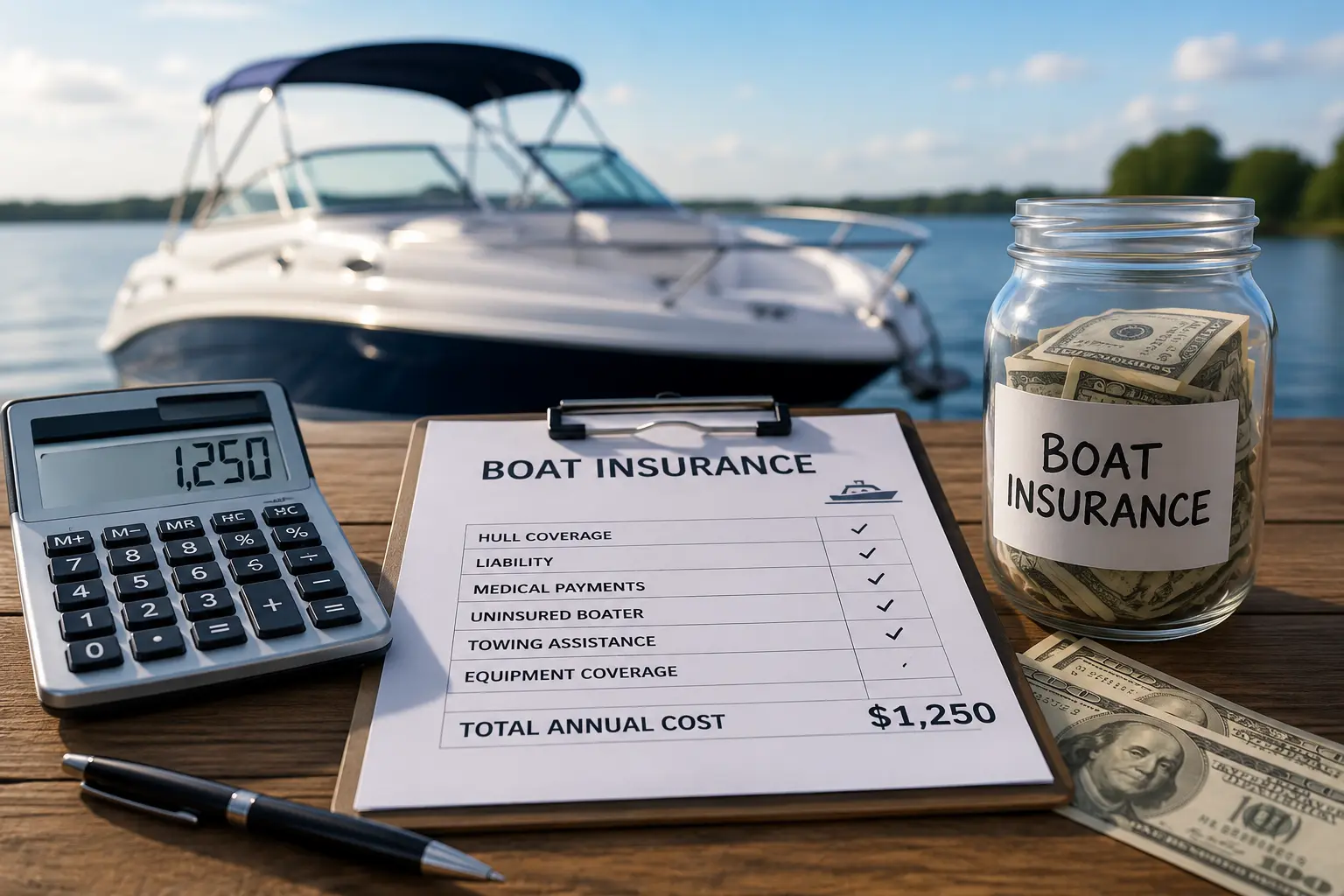
There’s no one price it’s like asking the average price of a car. Two pricing models cover most situations:
- Liability-only: typically $200-$500 per year.
- Comprehensive (full) coverage: about 1.5% of the boat’s insured value per year on average, generally in a 1%-5% range depending on risk. For example, a $20,000 boat ≈ ~$300/year (~$25/month); a $100,000 cruiser ≈ ~$1,000-$5,000/year.
What affects your premium
- Boat type, size, age, and value (and horsepower faster boats cost more; diesel is often viewed as lower risk).
- Where and how you use it coastal/hurricane-prone waters cost more than an inland lake; watersports and frequent use raise rates.
- Your experience and record clean boating/driving history pays less; in some states credit is a factor.
- Coverage choices limits, valuation method, and deductibles (commonly $500-$1,000; higher deductibles lower the premium).
- Older boats (15-20+ years) may need a marine survey to confirm condition.
Discounts to ask for
- Completing an accredited boating safety course (see the BoatUS Foundation)
- Lay-up periods (boat out of the water off-season)
- Freshwater-only boating and diesel engines
- Claims-free / experienced-boater history
- Bundling with your home or auto policy
How to choose a boat insurance policy
Because boat policies are less standardized than auto, the details vary so compare like-for-like quotes from three or four insurers, with the same coverages, limits, and deductibles, and all your discounts applied.
Before you commit, vet the company:
- Check its financial strength rating at A.M. Best aim for at least an A so you’re confident it can pay a claim decades from now.
- Look up its complaint record and licensing through the NAIC and your state insurance department.
- If the insurer also writes auto policies, the J.D. Power claims-satisfaction studies give a feel for how it handles claims.
Boat insurance providers to compare
Several established carriers specialize in or offer strong boat coverage. Get quotes from a few and compare the actual numbers and terms rather than relying on any generic ranking:
- Progressive widely available, online quoting, many add-ons.
- Nationwide boat policies with bundling discounts.
- BoatUS (and Geico Marine) boat-specialist coverage with on-water towing tie-ins.
- SkiSafe specialist in boat and watercraft coverage.
- State Farm, Markel, Allstate other commonly compared options.
Tips for senior boaters

A few things matter more as you keep boating into your 70s and 80s:
- Ask how age affects renewals. Confirm whether premiums rise by age band even with a clean record and by how much.
- Prioritize easy service. Look for an insurer with a simple website, multiple ways to reach a human, and 24/7 claims support.
- Match coverage to how you actually boat now. If you’ve shifted to shorter, calmer outings, your navigational limits and usage can lower your premium.
- Keep up safety courses. They’re a discount and a genuine refresher.
Frequently asked questions
How much does boat insurance cost per month?
Most boaters pay roughly $25-$125 a month. Liability-only is often $200-$500 a year; comprehensive coverage averages about 1.5% of the boat’s value annually.
Do I legally need boat insurance?
Not under federal law, and only some states require it. But most marinas require proof of coverage, and any lender will require it until the boat loan is paid off.
Does homeowners insurance cover a boat?
Only in limited cases small, low-value, non-motorized boats may have some coverage. Larger or motorized boats, and liability, generally need a dedicated boat policy.
What does boat insurance not cover?
Typically wear and tear, gradual deterioration, mechanical/manufacturing defects, and damage from marine life, mold, or insects.
What’s the difference between agreed value and actual cash value?
Agreed value pays a pre-set amount with no depreciation (higher premium); actual cash value pays the depreciated value at the time of loss (lower premium).
How can I lower my boat insurance premium?
Take a boating safety course, choose a higher deductible, use lay-up periods, bundle with home/auto, and keep a claims-free record.
Do I need insurance for a small boat or canoe?
It may fall under limited homeowners coverage, but a dedicated policy is still worth it for liability if the boat is motorized.
How much liability coverage do I need?
Many owners carry $300,000-$500,000; $1,000,000 is often recommended for larger or faster boats given how high injury and property claims can run.
Final thoughts
Boat insurance does one job well: it keeps a bad day on the water from turning into a financial crisis on land. Decide between liability-only and comprehensive, pick a valuation method that fits your boat’s age and value, apply every discount you qualify for, and choose a financially strong insurer with service you’ll actually be able to reach. For related coverage, see our guides to RV insurance and the rest of our senior insurance guides.

Sharon O'Day - Senior Advisor
Sharon O'Day is the Health editor at Grandfolk, where she commissions and reviews fitness, wellness, and senior-care content for accuracy, clarity, and real-world usefulness. At 60-plus, she writes for older adults from lived experience, testing the advice against the questions she and her peers actually ask. She focuses on guidance that is honest about both the benefits and the limits, and that always points readers back to their own doctor for personal decisions.