
Travel Insurance Guide 2026: What Seniors Should Know
Last Reviewed: June 2026 | By Sharon O’Day, Senior Advisor | Fact-checked by the Grandfolk Editorial Team






When the person selling you a trip asks, Do you want insurance?, it’s almost as automatic as Do you want fries with that? The smarter question is Do I need it? The way to answer is to list everything that could go wrong, judge how likely each is and whether you could absorb the cost, and then buy coverage only for the gaps you can’t comfortably cover yourself. For seniors especially when a medical emergency far from home can be ruinously expensive and Medicare often won’t help abroad travel insurance can be the difference between a setback and a financial disaster.
Do you actually need travel insurance?
Travel insurance is about money, not experiences it can’t un-ruin a trip, only put money back in your account. So before buying, check what you already have: many credit cards include trip-cancellation, baggage, or rental-car protection; homeowners policies may cover lost belongings; and your health plan may extend somewhere. Buy travel insurance to fill what’s left exposed chiefly large, non-refundable prepayments and out-of-country medical and evacuation costs.
What travel insurance covers
A comprehensive policy bundles several coverages; most companies sell tiered plans that mix these, plus add-on riders:
Trip cancellation and interruption
Reimburses non-refundable, prepaid costs (flights, lodging, tours) if you cancel before departure or cut a trip short for a covered reason typically illness, injury, a death in the family, or certain emergencies. Read the list of covered reasons carefully.
Emergency medical and dental
Pays for medical care that arises during the trip. This is the coverage seniors should weight most heavily for international travel, since U.S. health coverage often doesn’t follow you abroad (see the Medicare section below). Aim for at least $100,000 in emergency medical coverage for overseas trips.
Medical evacuation and repatriation
Pays to transport you to adequate care or home in an emergency. An air ambulance from a remote location can cost tens of thousands of dollars, so look for $250,000–$500,000 in evacuation coverage for international or remote travel. If you want this as a standalone benefit, see our guide to medical air transport.
Baggage, travel delay, and 24/7 assistance
Covers lost, stolen, or delayed luggage, expenses from significant travel delays, and around-the-clock assistance (rebooking, finding care, replacing lost medications). Many policies also include Accidental Death & Dismemberment useful unless you already carry separate life insurance.
Cancel For Any Reason (CFAR) coverage
Standard cancellation only pays for listed reasons. Cancel For Any Reason (CFAR) is an optional upgrade that lets you cancel for any reason including simply changing your mind and still recover 50–75% of your non-refundable costs. The trade-offs: it costs extra (often raising the premium by ~40%), you usually must buy it within 14–21 days of your first trip payment, insure 100% of your prepaid trip cost, and cancel at least 48 hours before departure. For seniors making large, non-refundable bookings, CFAR can be worth the premium for the flexibility alone.
Travel insurance and Medicare: what’s covered abroad
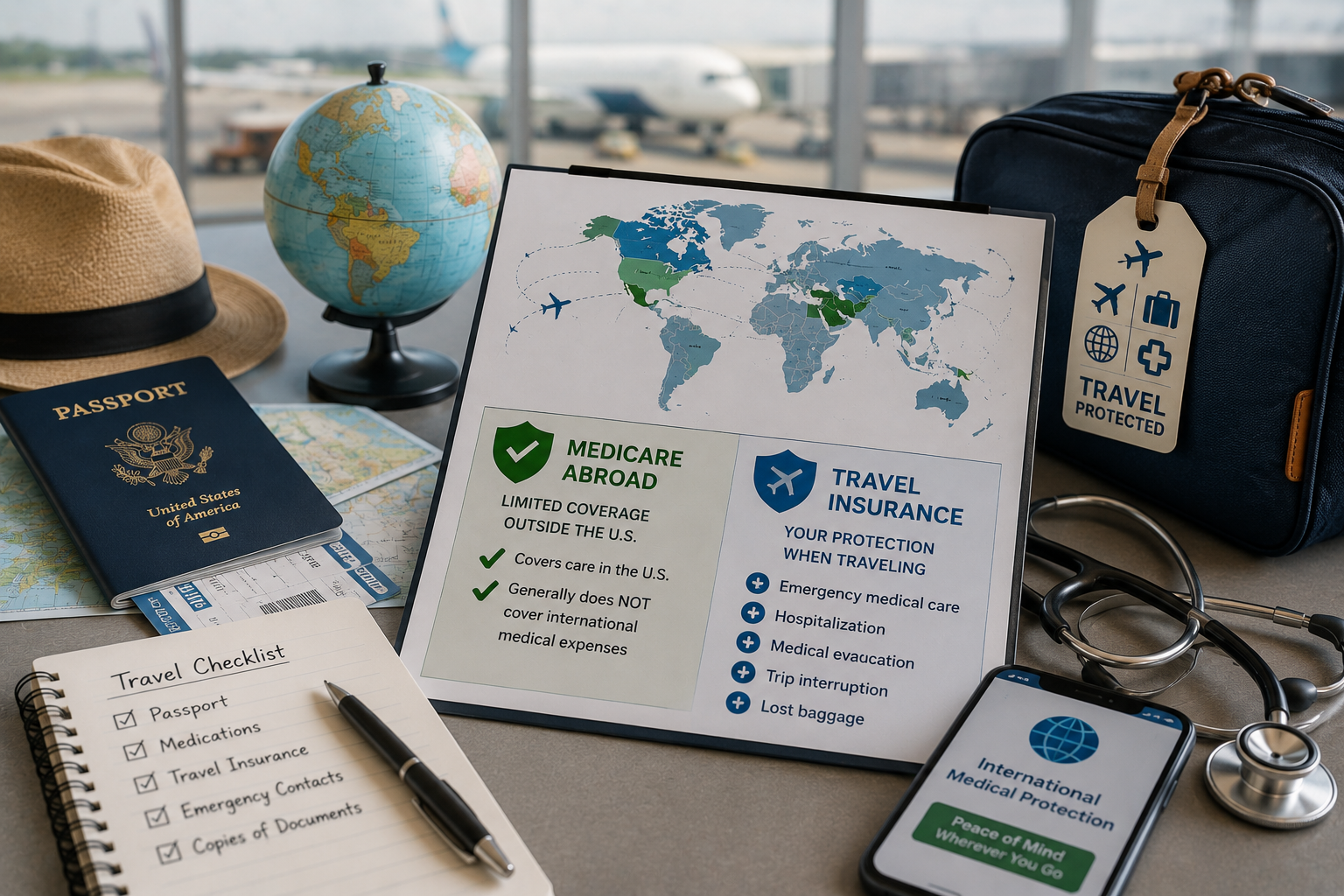
This is the gap that catches seniors. Original Medicare (Parts A and B) generally does not cover health care outside the United States. Some Medicare Supplement (Medigap) plans C, D, F, G, M, and N cover 80% of foreign-travel emergency care, after a $250 deductible, up to a $50,000 lifetime maximum which sounds like a lot until you face a serious hospitalization or evacuation overseas. Some Medicare Advantage plans add limited worldwide emergency coverage. Bottom line: for international trips, a travel medical plan with real limits fills a gap your everyday coverage almost certainly leaves open. The State Department’s health-abroad guidance and Medicare.gov on travel both spell this out.
Primary vs. secondary coverage (and why it matters)
Travel insurance isn’t as simple to use as flashing a Medicare card you’ll often pay first and file for reimbursement. How quickly you’re made whole depends on the plan type:
- Primary coverage pays your claim first, without requiring you to exhaust your other insurers faster, and some primary medical plans will even pay a hospital directly so you can be admitted.
- Secondary coverage pays only after your other insurers (health, homeowners, etc.) have paid their share you’ll still get reimbursed, but it takes longer.
Where you can, choose primary coverage, especially for medical and evacuation benefits.
Pre-existing conditions and waivers
Most policies exclude pre-existing conditions unless you qualify for a waiver and the waiver almost always requires you to buy the policy within a short window (commonly 14–21 days) of your first trip payment and be medically able to travel when you buy. Miss that window and a flare-up of an existing condition may not be covered. If you have any chronic conditions, lock in the policy (and the waiver) early.
How much does travel insurance cost?
Travel insurance typically runs 4–10% of your total prepaid trip cost so a $5,000 trip might cost $200–$500 to insure. Because premiums are partly age-rated, seniors tend to land toward the higher end (often 8–12%). Cost rises with more coverage, higher medical/evacuation limits, CFAR, and your age. If you mainly need medical protection (for example, on a trip with little prepaid, non-refundable cost), a cheaper medical-only plan may be all you need.
How to choose a policy (and a senior-specific checklist)
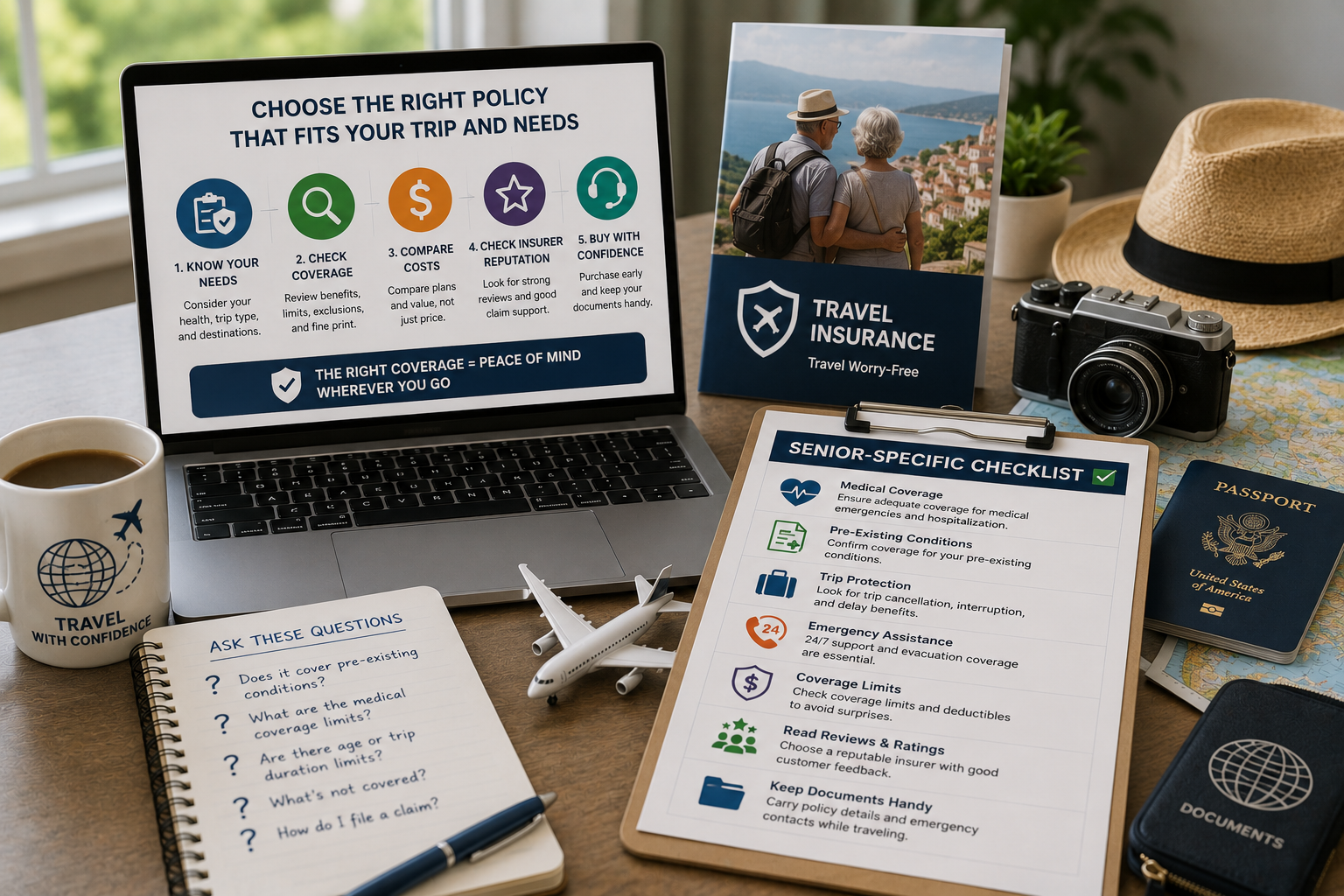
A few guidelines stand out:
- Choose a big, financially strong insurer so it’s there when you file a claim check the company’s rating at A.M. Best.
- Prefer primary over secondary coverage.
- Match age limits and medical limits to your needs: at least $100,000 medical and $250,000–$500,000 evacuation for international travel.
- Confirm the pre-existing-condition waiver and the deadline to qualify.
- Value 24/7 emergency assistance can they help replace lost medications, arrange care, or provide language help at 3 a.m.?
- Beware travel-supplier waiver plans sold by cruise lines and tour operators: these are not regulated by your state insurance department and offer minimal real protection don’t confuse them with a true insurance policy.
- Always read the certificate before you buy: covered reasons, exclusions, and limits. The US Travel Insurance Association has neutral consumer guidance.
Travel insurance providers to compare
Several established, reputable insurers are commonly compared for senior travel. Get quotes from a few (a comparison marketplace makes this easy) and compare the actual coverage and limits rather than relying on a generic ranking:
- Travel Insured International (Crum & Forster)
- Travelex Insurance Services
- AIG Travel Guard
- Arch RoamRight no age limits on core plans; strong customer service
- Allianz Global Assistance
- Others worth a quote: Seven Corners, Generali Global Assistance, IMG, Berkshire Hathaway Travel Protection
Frequently asked questions
Is travel insurance worth it for seniors?
Often yes especially for international trips, where Original Medicare usually won’t cover care abroad and a medical emergency or evacuation can cost tens of thousands of dollars. For a cheap, fully refundable domestic trip, it may be unnecessary.
How much does travel insurance cost?
Typically 4–10% of your total prepaid trip cost, with seniors usually toward the higher end (8–12%). Cost rises with more coverage, higher limits, CFAR, and age.
Does Medicare cover medical care abroad?
Original Medicare generally does not. Some Medigap plans cover 80% of foreign emergency care after a $250 deductible, up to a $50,000 lifetime maximum which is why a travel medical plan matters for overseas trips.
What is Cancel For Any Reason (CFAR) coverage?
An optional upgrade that lets you cancel for any reason and recover 50–75% of non-refundable costs. You generally must buy it within 14–21 days of your first payment, insure 100% of your trip cost, and cancel at least 48 hours before departure.
Does travel insurance cover pre-existing conditions?
Only if you qualify for a waiver, which usually requires buying the policy within 14–21 days of your first trip payment and being medically able to travel at purchase.
What is the difference between primary and secondary coverage?
Primary coverage pays your claim first without requiring you to use your other insurance; secondary coverage pays only after your other insurers have paid, so reimbursement takes longer.
When should I buy travel insurance?
Soon after your first trip payment ideally within the 14–21-day window so you preserve eligibility for CFAR and the pre-existing-condition waiver.
How much medical and evacuation coverage do I need?
For international travel, aim for at least $100,000 in emergency medical coverage and $250,000–$500,000 in medical evacuation coverage.
Final thoughts
Travel insurance is about protecting money you can’t afford to lose large prepayments and, above all, out-of-country medical and evacuation costs that Medicare usually won’t touch. Buy only to fill your real gaps, favor a financially strong insurer with primary coverage, lock in early to keep your pre-existing-condition waiver and CFAR options, set medical and evacuation limits high enough for where you’re going, and read the certificate before you pay. For related needs, see our guides to medical air transport, Medicare Supplement insurance, and the rest of our senior insurance guides.

Sharon O'Day - Senior Advisor
Sharon O'Day is the Health editor at Grandfolk, where she commissions and reviews fitness, wellness, and senior-care content for accuracy, clarity, and real-world usefulness. At 60-plus, she writes for older adults from lived experience, testing the advice against the questions she and her peers actually ask. She focuses on guidance that is honest about both the benefits and the limits, and that always points readers back to their own doctor for personal decisions.