
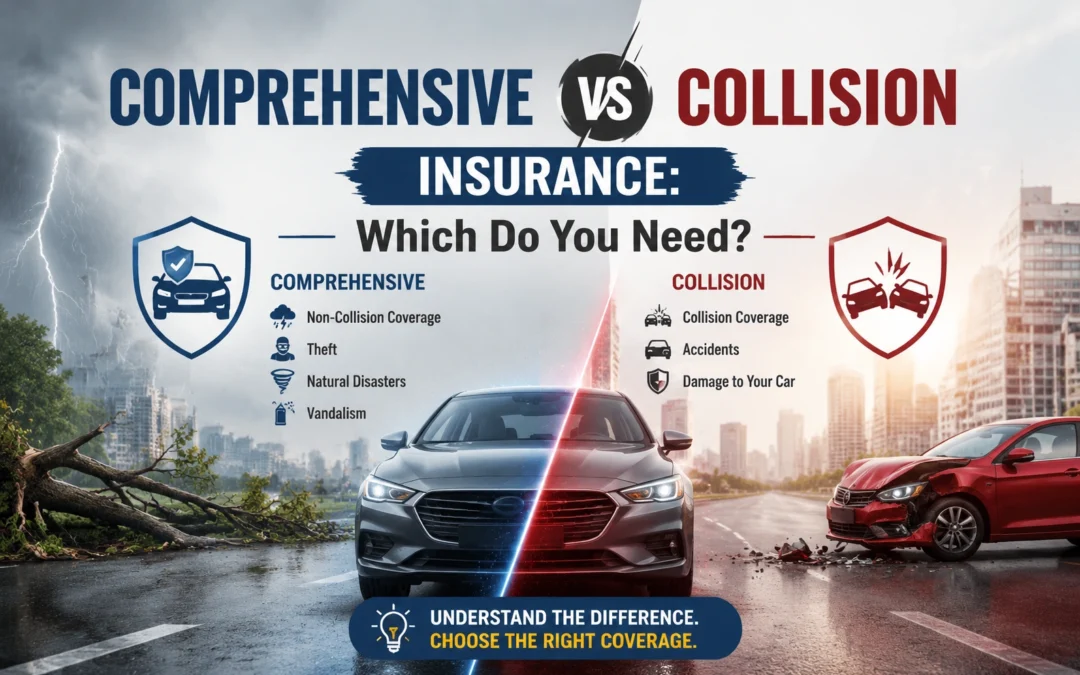
If you have ever stared at your auto insurance policy wondering what the difference is between comprehensive and collision coverage, you are not alone. These two coverages are often bundled together, but they protect you against completely different situations. Choosing the right one or knowing whether you need both can save you hundreds of dollars a year while making sure you are not left with a large repair bill after an unexpected event.
Here is a clear, no-confusion breakdown of comprehensive vs collision insurance so you can make the right call for your vehicle and budget.
What Is Collision Insurance?
Collision insurance covers damage to your vehicle that results from a collision, regardless of who is at fault. This includes:
- Hitting another vehicle
- Being hit by another driver
- Striking a guardrail, fence, tree, or pole
- Rolling or flipping your vehicle
- Hitting a pothole that causes significant damage
If you cause an accident or hit an object, collision coverage pays to repair or replace your car up to its actual cash value, minus your deductible. Without it, you are personally responsible for repair costs even when the accident was entirely your fault.
Collision coverage is particularly valuable for newer vehicles or cars that would be expensive to repair. It does not cover injuries, damage to another person’s vehicle, or non-collision events like theft or natural disasters.
What Is Comprehensive Insurance?
Comprehensive insurance covers damage to your vehicle from events that are outside your control and not caused by a collision. It is sometimes called “other than collision” coverage. Events covered include:
- Theft or vandalism
- Fire or explosion
- Hail, flooding, and severe weather
- Falling objects such as trees or debris
- Animal strikes, including deer collisions
- Civil unrest or riots
Like collision, comprehensive pays up to the actual cash value of your vehicle minus your deductible. It is the coverage that protects you from the unpredictable, from a hailstorm denting your hood to a thief taking your car overnight.
Key Differences: Comprehensive vs Collision
| Factor | Collision Insurance | Comprehensive Insurance |
|---|---|---|
| What triggers a claim | Your car hits something or is hit | Non-collision event: theft, weather, animals |
| Fault requirement | Covers regardless of fault | No fault involved |
| Average annual cost | $290 to $490 | $130 to $200 |
| Required by lenders | Yes, if car is financed or leased | Yes, if car is financed or leased |
| Covers theft | No | Yes |
| Covers weather damage | No | Yes |
How Much Does Each Coverage Cost?
Comprehensive insurance is significantly cheaper than collision coverage. On average, comprehensive adds around $130 to $200 per year to your premium, while collision typically costs $290 to $490 per year. Combined, the two coverages average about $400 to $700 annually depending on your vehicle, location, driving history, and deductible.
Your deductible is the amount you pay out of pocket before insurance covers the rest. Common deductible options range from $250 to $1,000. A higher deductible lowers your monthly premium but increases what you owe after a claim. Choosing the right deductible is a balance between what you can afford to pay monthly and what you can absorb after an unexpected loss.

Rates also vary significantly by insurer. Comparing quotes from multiple providers is the most effective way to find affordable coverage without sacrificing protection. You can read Progressive Insurance Reviews and State Farm Insurance Reviews to see how two of the largest auto insurers rate on price, claims handling, and customer service before making a decision.
Do You Need Both?
If your car is financed or leased, your lender almost certainly requires both comprehensive and collision coverage. This protects their financial interest in the vehicle until you own it outright.
If you own your car free and clear, the decision comes down to the value of your vehicle and your financial situation. A general rule used by financial advisors is: if your annual premium for both coverages exceeds 10% of your car’s current market value, it may not be worth carrying them. For example, if your car is worth $4,000 and you are paying $600 per year for comprehensive and collision combined, you are approaching the point where dropping one or both makes financial sense.
The Insurance Information Institute recommends reviewing your coverage levels annually as your vehicle depreciates, to make sure you are not over-insuring an older car.
When to Drop One or Both Coverages
Consider dropping collision coverage when:
- Your car is older and its market value is under $4,000 to $5,000
- The annual collision premium exceeds 10% of the car’s value
- You have enough savings to cover repair or replacement costs out of pocket
Comprehensive coverage is generally worth keeping even on older vehicles because it is inexpensive and covers high-cost events like theft and flood damage that have nothing to do with your driving. Many drivers who drop collision still retain comprehensive for this reason.
How to Choose the Right Coverage for Your Situation
The right choice depends on four factors: your car’s current value, whether you have a loan or lease, your local risk environment, and your emergency savings.
Drivers in areas with high theft rates, severe weather, or heavy deer populations benefit more from comprehensive. Drivers who commute heavily in high-traffic areas face greater collision risk. If you are unsure what your full coverage should look like, comparing quotes across providers is a smart starting point. See cheap car insurance options for a comparison of budget-friendly auto insurance plans, or review Liberty Mutual Car Insurance Reviews to evaluate one of the more commonly recommended providers for comprehensive and collision bundling.
Frequently Asked Questions
Is comprehensive or collision insurance better?
Neither is universally better. Collision covers driving accidents while comprehensive covers theft, weather, and other non-collision events. Most drivers benefit from carrying both, especially if the vehicle is financed or relatively new. For older paid-off vehicles, the decision comes down to the car’s value versus the cost of coverage.
Can I have comprehensive without collision?
Yes. Comprehensive and collision are separate coverages and can be purchased independently. Many drivers on older vehicles drop collision while keeping comprehensive because comprehensive is cheaper and protects against high-impact events like theft and flood damage.
What deductible should I choose for comprehensive and collision?
A $500 deductible is the most common starting point. Choosing a higher deductible reduces your premium but increases your out-of-pocket cost after a claim. Choose a deductible amount you could comfortably pay from savings without financial strain if you needed to file a claim tomorrow.